Home Blog Page 14

Living With The Legend
By
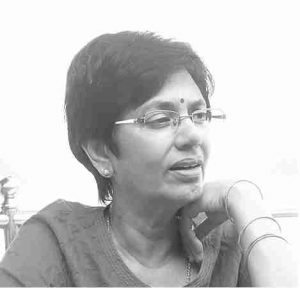
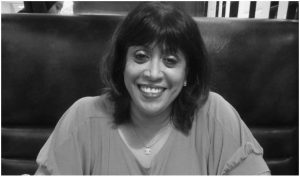
R.Selvarani: He had just returned from Germany after completing his degree and was appointed as a National Coach by the Ministry of Sports.
On my first day at the Kampung Pandan track I was introduced to this tall, dark and handsome guy named Ishtiaq Mobarak. He was my mentor. My mind went blank and I couldn’t focus on what he was saying for the first couple of minutes. I was a young and naive girl eager to become a champion and when he agreed to accept me as his athlete, words could not describe the joy that I felt…Gosh…I just couldn’t wait to return home to share the news with my family, neighbours and friends.
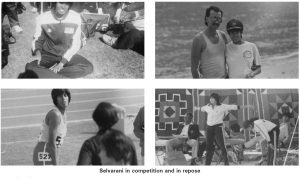
I started off as a high jumper, but within a year he transformed me into a hurdler. Thereafter my journey to becoming a champion started. I was then a little plump and some athletes used to tease me and Ish would always “shut” them up. There were also a couple of coaches who said that he was wasting his time coaching me. Ish took that as a challenge and proved them wrong.

1st Kiss from My Mentor
Ish was offered an awesomely-paid job in Singapore. House, car, utility bills all taken care of by the company, but yet he was not happy. Why? Because coaching was his passion and he was missing all his athletes in KL.
Every weekend he would fly back to coach us, his athletes. One weekend the athletes had organised a party. Ish arrived at the venue, took me to the dance floor and we danced non-stop for two hours. Finally when he sent me back he kissed my hand and said goodnight. I almost fainted (being the naive girl). It was an amazing feeling getting a kiss from your then mentor. I tied a plastic bag over my hand when I took my shower that night. Whole of the following day I was in a daze thinking about the two hours of non-stop dancing, and the kiss on my hand…
Great Coach and Motivator
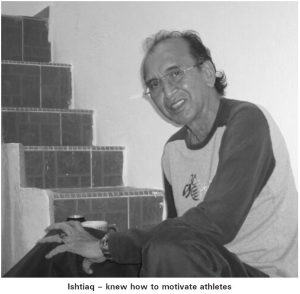
Ish had his ways of communicating with athletes, coaches, parents etc. He could identify talents, he could handle the most difficult athletes. He does a fantastic job motivating athletes during competitions. Many a time he had motivated stressed out athletes, and second best athletes into winners.
His athletes just loved spending time with him. Many of them loved to visit him on off training days. Some would also stay at our home over the weekends.
There are also athletes who are not coached by him but would love to talk to him before they go for competitions.

A Romantic and Passionate Person
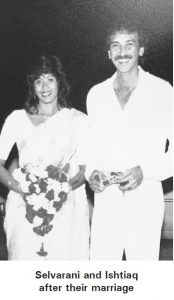
I love the name Ramesh so when Ish and I got married I secretly called him Ramesh at times. On our 1st Valentine’s Day after marriage Ish sent a basket of roses to the house (we were staying with our parents at that point of time) with a beautiful message to me and signed off as ‘LOVE, RAMESH’
Can you imagine how my parents reacted when they saw the bouquet. Both Ish and I worked on that day and when we returned home, saw my dad walking in the living room restlessly. Mum was seated in the living room, looking pale and scared. In their minds both were wondering how Ish was going to react when he reads the message on the basket of flowers. Thank God they were not heart patients then. Upon seeing how my parents were reacting he quickly laughed it out as he didn’t want to put my parents through further stress.
Another Valentines Episode I had left for work (at that point of time we were living on our own). Mid-day he called to say that he was not feeling well and needed to be taken to the hospital. I applied for Emergency Leave and rushed home. As I got into the living room I noticed a large vase of roses (my heart melted) but continued to rush to the bedroom because I kept calling Ish but there was no response. I had a beautiful and amazing surprise as I reached the bedroom door…the whole bedroom walls had stalks of roses pasted on, I am just blessed to have had this romantic man as my husband.
– 1st Wedding Anniversary
Ish sends me a bouquet of flowers to the office and the message read: “I’m blessed and thank you for being my wife – 1 down, 99 years to go”. But as it turned out, God loved him more, and had to take him away after 28 years.
Embarrassing / Funny / Romantic
Once we went out to listen to music at a diners. He stood on his chair and then announced that he loves me.
On another occasion, it was my birthday and he took the girls (both our daughters) and me to an Italian restaurant for dinner. As we were having dinner, we talked about love and family and he was telling our daughters about how much he loved me and how blessed he was to have us in his life.
At that point, he stood up with his hands raised and about to get the attention of the people in the restaurant, to announce his love for his family.
However this time around I was quick enough to stop him, while our two girls kept encouraging him to continue with his action. Gosh! I had a hell of a time trying to stop him from doing so.
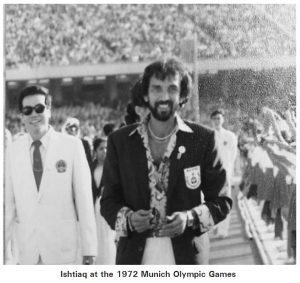

Grooming
Ish’s teaching and guidance contributed to my success as a Customer Service Manager at my work place. He was one person that I could confide in when I have had a stressful day at work. Particularly so, when I used to have problems with my immediate supervisor. He would listen, then correct me if I was wrong and then showed me a better approach.
Ish was also my personal grooming/dressing adviser. He taught me how to mix and match my clothes, to make up, using the right accessories and even the hair style.
When I first joined him as an athlete and was getting into national ranks, Ish took me to his friend’s salon and got him to restyle my hair which was really short (I had shoulder length hair then). According to him, the shoulder length hair was a hindrance to training. Just imagine how I felt at that point of time (an Indian girl with extremely short hair). I cried and cried and was so furious with him. That night there was a dinner party for the athletes, and everyone who saw me complimented me on my new look. It was only then did I start smiling.
Loves Children
Ish had always spoken about adopting abandoned children. I therefore started contributing to a children’s world organisation. Two weeks before he passed away Ish touched on the same subject matter. As such I had increased my contribution (on his behalf) to the said organisation and also to a local organisation.
Nature Lover
Ish had a way of communicating with animals. One should watch him communicating with the monkeys at our neighborhood.
Our second daughter, Shakira, spends lots of time with her daddy watching National Geographic, Animal Planet etc. Both of them were always exchanging notes on this subject.
Today Shakira has made her name as one of the outstanding naturalists in Langkawi. Credit also goes to her uncle, Irshad Mobarak (Ishtiaq’s brother) who has guided her in this field.
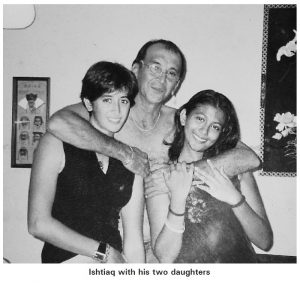
Hobbies
He loved Bikes & Cars – spent loads of time at bike shops/workshops
Loved gardening Likes & Dislikes He ate when he was hungry but every night for supper he had a glass of milk with something sweet i.e. peanut biscuits (Kacang tumbuk) / Indian milk candies.
He loved fruits and his favourite were mangoes.
He didn’t like shopping, be it market, grocer, departmental stores. When we got married his mum advised me that I would have to shop for his clothes too.
He loved simple food, wore simple clothes except when he had to attend a function.
He was not a party going man. In general he was a simple man who lived a simple life.
His threshold for pain was just amazing. He hated going to visit the doctor. If he fell sick as in flu, fever he would not take any medication, instead would drink a lot of water and ate fruits and rest.
He was a simple, humble and passionate person. THANK YOU ‘YANG’ for choosing me as your life partner.
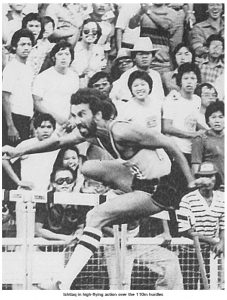

I loved you as my mentor, I loved you as my coach, I loved you as my boyfriend and most of all I loved you as my husband, and will continue loving you till we meet again…
Girls and I still miss you dearly and it still hurts a lot not having you around, but we know that you are a star up above watching over us.
Oh! What a Letdown!

By
S.Sabapathy: Running was my true passion. The joy of training and learning new methods to push your body to new heights was always a priority.

And from a teenager I loved running and winning titles for myself and bringing glory to my country.

But sometimes your country and athletics officials don’t appreciate your commitment, the efforts, and sacrifices you make for the nation.

One disappointing incident took place after the September 1973 SEAP Games in Singapore.

Just before the start of this SEAP Games, the late Tan Sri Ghazali Shafee, president of the Malaysian Amateur Athletic Union (MAAU) back then, promised us that all gold medal winners will compete in November’s inaugural Asian Track & Field championships in Manila.

This was a great incentive to most of us to excel. I won a gold in the 4 x 400m relay, a silver in the 200m, and a bronze in the 4 x 100m relay.

Being a gold medal winner in the relay, I was called up with about 20 others for a one month centralised training stint in Kuala Lumpur.

However, just two days before our departure to Manila, our dream to participate in the Asian meet was shattered when we were told to break camp and return home.

Anthony Rogers, the then MAAU secretary told us that he was notified by a higher authority that this athletics team to Manila resembled more like a “team from Madras.”
Apart from me, I still remember the others…M. Dattaya, Karu Selvaratnam, B.S. Payadesa, Asir Victor, M. Subramaniam, Yamunah Nair, Kumarasen and Ramasamy.
Some were angry, but all of us were totally dejected and offended by the “racial labelling.” We felt let down and rejected by our own country.

One is Not Enough!

By
J.B.Khoo: After the first break of the 5-man team event, we were leading the host nation Thailand by 144 pins in the 1978 Asian Games bowling event.
We had a break in between the game and we were preparing to leave for  our hotel. However P.S. Nathan (MTBC president) told us that in no uncertain terms whatever we did, we were not allowed to have a change of outfits (not even our underwears).
As it was pointless travelling all the way to our hotel, I requested that we have a bath at a nearby massage parlour and MTBC pays for the bath.
We returned to the bowling venue and continued our game in the same sweaty outfits. In the ensuing marathon session, we went on to capture Malaysia’s first gold medal in the Asian Games. The only other gold was won by Saik Oik Cum in the 400m athletics..
For our sterling performance. the late Dato Mohamed Rahmat, the chef-de-mission, promised us a bottle of champagne.
I told him that one bottle he was offfering us was just good enough only for me. On reaching our hotel rooms, there were three bottles waiting for us to celebrate with.
(The 5-man team: Allan Hooi, J.B. Koo, Edward Lim, Holloway Cheah, P.S.Nathan & Lee Kok Hong). feared for our lives. The whole night, we couldn’t sleep as we were afraid that the crowd would have knocked down our doors and taken our lives. At day break, we were informed that we were going to be rushed back to Kuala Lumpur and that the tournament would be temporarily suspended.
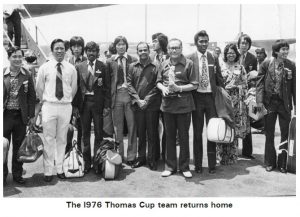
The ride to the airport wasn’t without any suspense. Not only were we escorted by the police but imagine this…we had tanks as part of the convoy going to the airport. Until we were safely on Malaysian soil, we didn’t feel safe. We were even suspicious of the plane that was bringing us back, a Garuda which flew us to Singapore and from there we took a connecting flight to Subang Airport in Kuala Lumpur.
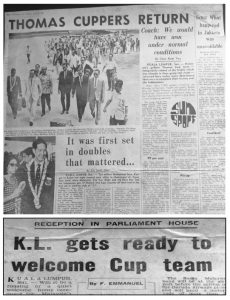
Touching down at Subang Airport, only then could we breathe easy. We were greeted with open arms by not only our loved ones but all of Malaysia. IBF decided later on that the tie would continue in New Zealand, on a neutral venue. Indonesia didn’t agree to the decision and it was then that the Thomas Cup was awarded to us.
This whole incident to me was like going to war for my country. The only difference was that instead of guns and bullets, we were only armed with badminton racquets and shuttlecocks! Everything else was so war-like…the rowdy crowd, the soldiers, the darkness, and the tanks.

(I dedicate this story to the late Norman Siebel, Sports Editor of The Straits Times, who was a great influence on me.)

Long & Lonely Track

By
Karu Selvaratnam: My early years (1960 – 1965) training as a national athlete, was a long and lonely journey.

I had joined the Royal Malaysian Navy (RMN) and was based in Woodlands, Singapore. There was a playing field, (under the Navy’s charge) outside the Base, which required a 500m jog from the Barracks.
Four to five times a week in the evenings, I was there virtually alone, carrying the hurdles, five to seven at a time to lay them along the track. The hurdles back then, were made of solid wood and steel frames. I tell you they were heavy, and painful when you knocked them.
Apart from carrying those heavy wooden hurdles with steel frames, I trained on my own, without a coach to guide me. But the task wasn’t over when I ended my training session. I had to carry them back into the storeroom, lock them up, and return the keys as I was accountable for the equipment.
I was an Engineering apprentice, attached to Her Majesty’s (HM) Dockyard in Sembawang, Singapore. It was a five-year training programme, with no salary, except for an allowance of $90 a month. I didn’t have the luxury of buying a starting block, so I had to make one.
To make myself more competitive, I would travel to Farrer Park by bus once a month on a Friday, and train with the likes of Jega (M. Jegathesan), and the other Singapore athletes over the weekend.
At Farrer Park, I trained on Friday evenings, Saturday and Sunday mornings. On Sunday evening I would take the 4pm bus back to the Naval Base.
Each weekend session to Farrer Park would cost me something in the region of about $25, if I stayed with a friend. If not, it could cost me an additional $5 per night at a budget hotel.

As I was also a National cricketer, there were some weekends, I skipped athletics training and played cricket in the Singapore league for Ceylon Sports Club (CSC) from 1961 to 1965. I also played cricket for Malaya and Malaysia from 1960 to 1965.
Each time I travelled to Kuala Lumpur, or Penang for a National meet, I would take the 10pm train that leaves Johor Baru and arrives in KL at 6.30 the following morning.
During the night journey I would sleep above the 3rd class seats where the luggage was kept. The next afternoon I was scheduled to run in the heats and, on Sunday in the finals. That same Sunday night I would take the night train back to JB, and catch the early morning bus to the Naval Base in Woodlands to report for duty.
If the meet was in Penang, I would leave JB a night earlier, arrive in KL at 6.30am the following morning, and take the 1.30pm train to Butterworth. These travels were tiring because soon after arriving at my destination, without much rest, I would be required to run the heats, semifinals and the finals of the 400m hurdles, the 400m flat and the 4x400m relay, all over in two days. Depending on entries, I could be running five to six 400m races in a weekend. This was quite a normal practice for all state, national meet and government services meets. In 1965 at the MAAU meet in Singapore, where I won 3 gold medals (400m hurdles, 400m flat and 4x400m relay), I ran a total of seven 400m  races, which included the heats, semifinals and the finals. On the second day, I ran four, 400m races, in one of which I set the national record of 52.7 sec in the 400m hurdles for the third time in my career.
In December 1965, I left for England, to begin my cadetship at the Britannia Royal Naval College (BRNC) in Dartmouth. And with that my career in athletics ended, or so I thought then.
But I made a comeback eight years later in the 1973 SEAP Games in Singapore, and had the distinct honour of being the Malaysian contingent’s captain.
I also came back to find a place in the National cricket team from 1978 to 1982, after which I retired. I captained the National team in 1980 against Hong Kong in the Inter Port Series.

Knockout Punch!

By
Tony Francis: Amidst the fog in my memory bank, one experience with Punch Gunalan stands out like a beacon because as someone said, the advantage of a bad memory is that one enjoys several times the same good things for the first time.
It was 1976. Gunalan had made a comeback but as a coach following the end of Malaysia’s golden era in badminton with the retirement three years earlier of Tan Aik Huang, Gunalan himself, Ng Boon Bee and Tan Aik Mong after the Bangkok debacle where Malaysia were embarrassed by Thailand in the Asian zone final after leading 3-1 overnight.
Now, it was a new game with a new generation of players. And Gunalan was on a roll. Early in the year he had taken a team comprising players barely out of their school shorts to a stunning win over Prakash Padukone’s India, coming from 4-1 down to triumph 5-4 in the Thomas Cup zone final in Lucknow.
And as many would recall, Gunalan was so ecstatic and choked with emotion during the post-match interview on radio that he kept saying “Fantabulous, fantabulous” so many times that sportswriters were left scrambling to see if there was such a word in the dictionary.
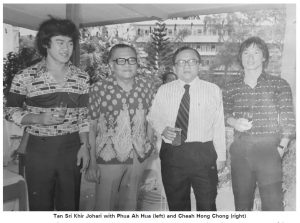
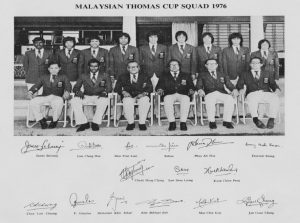
It was Gunalan’s way of describing a FANTAstic and faBULOUS comeback win. It was sheer grit and determination that won Saw Swee Leong, Phua Ah Hua, James Selvaraj, Moo Foot Lian, Dominic Soong and Cheah Hong Chong the tie. But would that be enough for the May-June Finals in Bangkok where the mighty Danes lie in wait in the semifinals? Even the most optimistic of pundits gave the ‘Punch Babes’ no chance against the likes of Sven Pri, an All-England champion, Fleming Delfs, Elo Hansen and Steen Skovgaard.
Like my editor-in-chief, the late Tan Sri Lee Siew Yee. He sent word that I was to take the first flight home after the match against the Danes. “Cut expenses. Save money. No way Malaysia are going to make it. We’ll get the wires (news agencies) to cover the final,” he said.
That had put me in a bind. I was scheduled to fly to Tehran from Bangkok the day after the final as a guest of the Iran FA for the Asian Cup soccer finals where coach M. Kuppan and Mokhtar Dahari and company were up against the best in the continent.
How do I explain to the good Tan Sri about the complications of cancellation and rebooking of flights? It was too late in the day. While Siew Yee was a scrooge when it came to company expenses, he was also passionate about badminton. We respected him for that. After all, he had sailed with Wong Peng Soon and the rest of the Malayan team to cover the first Thomas Cup finals in Preston, England, in 1949. So he knew what was in store for the ‘Punch Babes’. No chance. Or so he thought.
But like the rest, he didn’t reckon on a shrewd Gunalan exploiting the underdogs’ tag to the hilt. “I keep telling the players to believe and achieve,” Gunalan said during one breakfast session with the only two print Malaysian journalists who had made the trip – George Das of The Star and me representing the NST — in the hotel coffeehouse on the day of the match.
He was crafty too. He said he had taught them some tricks of the trade like squeezing the shuttle at crucial moments during service to catch the opponent offguard with the faster shuttle speed.
When I told Gunalan about my predicament if they lose, he laughed. “You must pray harder. Have faith. For us, winning is not impossible,” he said, pointing out that the Danes’ overconfidence and the enervating humidity in Bangkok could work in Malaysia’s favour and cause a Danish meltdown. “We just have to wear them out. We can do it,” he said.
And they did, winning 5-4 over the two nights, with Swee Leong scoring an unexpected point against Delfs and Dominic Soong and Cheah Hong Chong toppling the mighty Pri and Skovgaard for the winning point on the second night. And how Malaysia celebrated.
The win gave me a reprieve. I stayed on for the Final and knew I would be on the plane to Tehran from Bangkok. But I could imagine the look of disbelief on Siew Yee’s face back in Kuala Lumpur though I was sure he was among those who celebrated when Malaysia scored the winning point. It didn’t matter that we lost to the udy Hartono-powered Indonesians in the Final. ‘Punch Babes’ had achieved the impossible.
Gunalan became a celebrity that night and in the days that followed, soaking up the adulation and attention from the foreign media, particularly the Danish journalists. He was inundated with requests for interviews. And the questions were always the same: “How did you manage it? What was the secret? What did you do? “On all occasions, they got the same answer: “I have a bunch of fighters who had nothing to lose and everything to gain.”
In Denmark, they dubbed him the ‘Miracle Man’. In Bangkok, we called him the ‘Joker’ not only because he could make you laugh until your face hurts but because he could also be as mischievous as the next guy.
When George and I caught up with him in his hotel room, we talked and laughed about how people who had nothing to do with the team had hitched onto the bandwagon. Insignificant and unqualified officials were giving interviews on Malaysia’s resounding win as if they had made it happen.
So we decided to get a firsthand experience. It was decided that I should call a senior BAM administrative official and see his response. On the pretext of being a journalist from India who was calling from New Delhi, I managed only two questions but the ‘interview’ lasted a good hour as the official boasted about how he

was instrumental in selecting this young breed of fighters and motivated them and he was sure they would win the Thomas Cup and would be world beaters for years to come. When it was done, Gunalan, in his sarong, was rolling on the bed with tears from the uncontrollable laughter.
Thanks for the memories, Punch. As you would have said, “They were fantabulous.”

“To live in hearts we leave behind is not to die.” – Thomas Campbell, Scottish poet (1777-1844)

Punch – My Love, My Hero

By
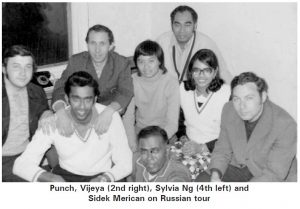
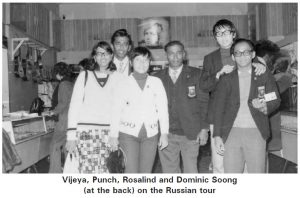
Vijeya Gunalan: It all started in early 1970. The badminton team doctor, Dr Ganeson and physical trainer, Mr Nadaraja tried to convince Punch to meet the only daughter of one, K.K Pillai, a good friend of theirs and an avid sportsman and sports fan in his own right.
However, the suave Punch refused, saying that he was not ready to meet anyone at the time, and wanted to concentrate on his badminton training and the 1970 Thomas Cup Finals. However, as fate would have it, I went to the Selangor Badminton Association Hall on 7th April 1970, with my little brother and cousins to get the players’ autographs. They were big fans of Punch and the team.
He immediately took a liking to me, and on the pretext of getting us tickets for the Thomas Cup Finals, he managed to get my phone number. He later confessed that he knew the moment he saw me, that I was the person he would share his life with… and he did.
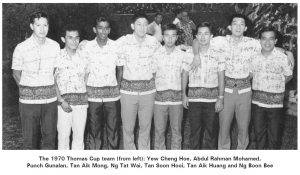
On the very next day, Yew Cheng Hoe, another member of the Thomas Cup squad called me and said that Punch would like to go out with me.  I was shocked and asked my dad’s permission. My dad immediately gave me the green light. He felt that I would be in safe hands with Punch, and as such he was more than happy with the situation.
At 3pm, a big car with some of the squad members arrived at my porch. They picked me up and dropped us both at the Odeon Cinema in Kuala Lumpur. We went to see Romeo and Juliet. Unlike the movie, our story had a far happier continuation that lasted 42 years.
We became much closer after that. On Sundays, I used to visit him at the chalet where the team were housed. I used to take tea and food for the team as well. We used to go for movies and to restaurants. The two places we frequented were Paris Corner in Bukit Bintang and Madras Restaurant in Jalan Ipoh. Paris corner is no more, but the Madras restaurant is still going strong in the heart of Kuala Lumpur.
My dad decided that we should get engaged soon, as people noticed this Indian girl going out with a famous sportsman. On 5th Sept 1970, we were engaged and on 12th June 1971 we got married. It was a grand affair at the Kalamandabam hall in Scott Road, Kuala Lumpur.
I still remember when we came down for the reception after the ceremony, Punch was swarmed with young fans asking for his autograph. Such was his appeal at the time. The next day, we had a dinner reception hosted by Punch at the Dewan Bahasa dan Pustaka, where the Yang di-Pertuan Besar Negeri Sembilan and his consort were the guests of honour.
Punch was born in Selangor, but grew up and lived with his mother and three sisters, in Seremban. Punch was not a rich man, as at the time, badminton players played more for the glory of the country than for money. Tournaments won were many but the reward was the honour brought to the country and not monetary. He was kindly loaned money by the Badminton Association of Malaysia, to host the reception. The money was returned to them with thanks.
Our marriage was full of love and happiness. The first year, he travelled a lot as a player. I never complained because that was his passion and he was conquering world badminton as a player. In late 1971, Punch was invited to play an exhibition match in Calgary, Canada. He decided to take me along and for the first time, I got to travel overseas in an airplane. We got the opportunity to stop at Hong Kong, Japan and Hawaii. On the return flight we stopped in California and I got to go to Disneyland. It all seemed like a dream to me at the time. I remember clearly in Hawaii, I decided to wake up early and make eggs for him. Unfortunately it was too salty. But Punch being himself, ate it just to pacify me. For many years after, he always used to tease me about the eggs fiasco in Hawaii. We were generally a very happy and loving couple.
Five years into our marriage, in 1976, our son Roshan was born. It was the happiest day of our lives. Punch, though busy, always made sure he spent as much time as possible with his son. He always considered his son his proudest achievement.
Fast forward to 2001, Punch was elated as his son graduated as a doctor. It was one of his happiest moments. That was only topped in 2007, when our darling grandson, Neraaj Madhav Roshan was born. Punch was a dotting grandfather. He would love to spend time with the grandson, but fate dealt a cruel twist to all of us. For, Punch passed on, just shy of Neraaj’s 5th birthday.
Punch was multi-talented. He could handle any job even when under pressure. He was also very forward thinking and would be two steps ahead in most of his plans and projects. He was also talented in other sports. He held the record for pole vaulting in his school, King George V (KGV), Seremban for many years. His forte was however badminton. From a young age, his dad used to train him and he would beat children who were more senior to him.
Punch was also a very good student. He was the top student in his school, KGV, and was the school captain in his final year. He obtained a scholarship from Tenaga Nasional to pursue mechanical engineering in Brighton, England. He returned to Malaysia after completing his studies and worked with Tenaga Nasional (formerly NEB) for five years. After that, he moved on to work at Dunlop. It was at this time that his love for badminton shone through, and he became more involved in the sport he loved. He began to involve himself more in the sport, in a coaching and administration capacity.
Punch received many awards locally, titles, and Sportsman of the Year awards. He received a Datukship from the King in 1992 after Malaysia’s Thomas Cup victory that year. He was the coach and manager for that legendary team on 1992. However, not many know that he was also given a Professorship by the Sports Institute of Sofia in Bulgaria. He received the award from the President of Bulgaria at the time, for his contribution to developing badminton in Bulgaria and other Eastern European countries.
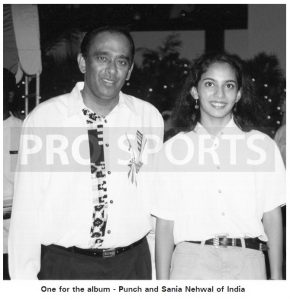
Until today, Punch is probably the only person who has excelled in the sport of badminton as a player, as a coach and manager and as an administrator. A ferocious attacking player who smashed like ‘punches’. He used the same vigour to train ‘his boys’, the Thomas Cup squad from 1988 to 1992. This culminated in Malaysia winning the Thomas Cup in 1992, the last time the nation had done so. He used the same guile he had on court, as an administrator.
A role he pursued to the highest level. Among his unknown successes of his time in the Badminton World Federation (BWF) was to bring the head office from England to Malaysia. Punch also was instrumental in changing the scoring system to the current 21- point system used internationally. His aim was to one day make badminton the number one racquet sport in the world, a dream which was not realised in his lifetime unfortunately. As much as he has done for the sport at every level, it is sad that the current generation do not know the legend of Punch Gunalan.
Anyone who knew Punch personally, would know him as a jovial, lovable character. Easy to get along with. Caring and accommodating to anyone he met. He cared a lot for his family and his friends.  Despite being busy, he would spend as much time as possible with me and his son. He would always put his family first.
He was a happy-go-lucky type of person. He had an infectious and characteristic laugh that was instantly recognizable to those who knew him. He would enjoy every celebration and party with his family and loved ones. Always being the loudest among the crowd. He was always happiest when he was surrounded by those he loved. As a husband he was kind and loving with a slight temper. However, his anger never lasted more than 15 minutes and we would be best of friends again soon after.
Despite travelling far and wide, every birthday of mine, he would send me a bouquet of flowers. That was the loving husband that he was, even until his final days. I miss that the most, every birthday since his passing.
Punch suffered a heart attack in 1995. However, he recovered and was well. Until he underwent surgery to his spine in 2006, and subsequently had a coronary artery bypass in 2007. In late 2008, he retired from his post as the Vice-President of the Badminton World Federation. After which, health issues started to take its toll on him. In late 2010 and early 2011, he was diagnosed with Parkinson’s disease. His condition slowed him down tremendously. The once active and eloquent Punch was becoming shakier physically and his speech was slurring and slow.
The worst was however yet to come. On 26th Feb 2012 he complained of back and stomach pains. Thinking nothing of it, he did not seek any treatment or consult any doctors initially.
As the pain persisted, we visited a doctor in Jalan Ipoh, only to find out that my beloved Punch had a tumour.
He was diagnosed with Cholangiocarcinoma (a rare cancer of the gallbladder) which had spread to the liver. The prognosis was bleak.
To me, at the time, I felt my whole world crumble into a heap. Punch was calmer than I was. He was consoling me as I was crying the whole journey back home.
We spoke to our son, who had a private talk with his father at the time. Something I was unaware of, until his passing.
On the 3rd of March 2012, we saw a hepatobiliary surgeon. He was not very optimistic of Punch’s chances. He had only given him six months.
I was not told of this duration, but my son, who is a doctor was well aware of the situation. We took him to several hospitals and consulted several doctors and specialists. Hoping against hope that something could be done for him. Over the next few months, he got weaker. He was tired, spoke very little and never really complained despite being in a lot of pain.
Punch took everything in his stride. Knowing he did not have much time left, all he wanted was what had kept him happy all these years… to be surrounded by those he loved. His three sisters who live in Melbourne came down and stayed with him over his last few months.
In June 2012, his condition worsened. He was weaker and jaundiced. His appetite was poor and he was losing weight. He also had difficulties moving his limbs as he was very weak. On 4th Aug 2012, he was admitted to Subang Jaya Medical Centre. The place brings such mixed memories for me. In 2007, the most joyous with the birth of our beloved grandson, and in 2012, the loss of my beloved Punch.
During his admission, he had a steady stream of visitors. From family, to his former school friends, friends from various stages of his career. He had visitors from overseas, he even had total strangers visit him, as they knew that Punch Gunalan was admitted. Several former and current badminton players whom he had previously trained visited him almost daily. We and our family were very touched by these players who spent time daily just to see him and keep him company, despite him being at his weakest. On 12th Aug, he tried to see the men’s singles finals of the London Olympics, where Lee Chong Wei played Lin Dan. He predicted a Lee Chong Wei victory, which wasn’t to be.
Punch loved to be surrounded by those close to him. He lived his life like that. And at his final passing, he was surrounded by those who loved him the most. I held his hand through the night, as my son sat on the other side of the bed from him. Knowing that he was fading away. Away from me after 42 years of love and memories.
At the dawn of 15th Aug 2012, at 6.00am, my Punch finally left me. He took his last breath holding my hand, and my son’s in his other hand. I felt like everything from me had gone. I felt a void that will never be filled again. Can I ever forget all this? Not until my last breath.
On that fateful day, I lost my pillar of strength, my soul-mate, my best friend….my legend, my hero. Five years down the line, I still miss everything about him. But I still cherish every moment I shared with him. For 42 years…. I was truly blessed.

Like A War Zone

By
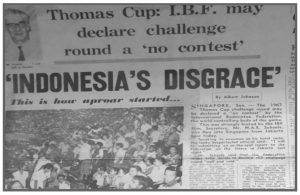
Yew Cheng Hoe: It is 1967, and it has been 12 years since the Thomas Cup landed on our shores. Since 1955, we’ve never gotten close enough to get our hands onto the ultimate trophy in the badminton world…the Thomas Cup! Now, in 1967, everything was different. We were now Malaysia, we were a new nation and with new blood streaming through our badminton veins, and new hopes to wrest the Thomas Cup from our rivals, Indonesia! Indonesia were the defending champions and it was up to us to take it away from them. Our manager, Khir Johari constantly drummed these words into our minds: “It is now or never”. The wait had to end, and we (Teh Kew San, Tan Aik Huang, Ng Boon Bee, Tan Yee

Khan, Billy Ng and myself) were the ones he placed the nation’s hopes on.
Flying to Jakarta for the final was nerve-wrecking. The Indonesians were a very boisterous and rowdy crowd, and to be in the infamous Istora stadium with this crowd was something no amount of training can prepare you for.
On the first day, we led 3-1. I took out Ferry Soneville, Aik Huang lost to Rudy Hartono, Boon Bee-Yee Khan beat Unang-Darmawan, and finally Aik Huang and Kew San managed to edge Muljadi and Susanto. Confidence was high in our camp. We were just two matches away from bringing the Cup back home.
The second day started just like the first day with Aik Huang beating Soneville and Hartono beating me. The score was now 4-2. We only needed one more win. And with Kew San losing his game in the third singles match, the tension was high as Boon Bee and Yee Khan took to the court for their match.It was an easy start for them and then the crowd started to react.
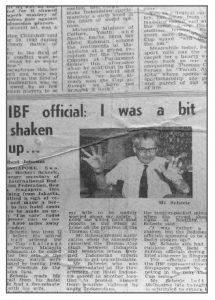
The noise in the stadium went up at least by five decibels. The crowd jeered every time we got the point and they started using their camera flashes just as we were taking the shots. We lost the second game 13-15.
It was at that time that the match official Herbert Scheele suspended the tournament unless the Indonesian badminton association cleared the stadium of all spectators as the situation was getting out of hand.
But the partisan fans were relentless. They invaded the courts, and started pulling the fuses off the DB boxes. The stadium was suddenly immersed in total darkness. We were terrified as just before the stadium went dark, even the soldiers were not able to control the crowd.
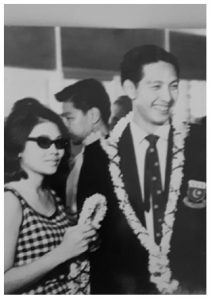
We thought the crowd was going to lynch us and with the soldiers losing control, we feared that they would have lost their guns and we would be killed. But we were quickly herded out of the stadium, all we could see were streams of light from their torches and one single flame from a lighter that led us away from mayhem.
Later we found out that the flame from the lighter came from Khir Johari. The crowd very quickly rushed down from the stands were on our tail and very quickly catching up. We barely managed get into our bus with the help of the police who then escorted us back to our hotel.Even at the hotel, there was already a crowd waiting for us. We had to enter Hotel Indonesia from its back entrance and quickly rushed up to our rooms. There we were informed by Khir that we would had to wait for IBF’s decision. We were hoping we could continue playing again the next day. It would have been difficult for us to play on as we.
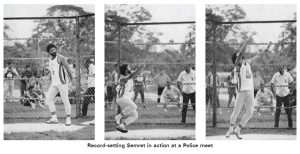
Too Good To Be True

By
Semret Singh: One of my sweetest memories in athletics was setting a Malaysian record for the hammer throw at the 1981 Australian Spring Championship in Perth.
Not only did I set a new distance of 50.5 metres for this event which bettered my Pitaji (father) Genda Singh’s record, I also defeated Australia‘s Matt Barber, the defending champion. This came after my three-month training stint in Perth. All of a sudden, people started taking notice of this Malaysian athlete at the Perry Lake Stadium. One of them was a talent scout attached to a European athletics club.
After the many back-slapping and bear hugs from my competitors and spectators, this talent scout took me aside and made me an offer to turn professional with his club.
He then handed me several sheets of paper, which were supposed to be a contract, and asked me to take my time to read them and get back to him the following day.
As I browsed through it that night in my room, I was totally surprised by its contents. It was like a once in a lifetime offer and I found it too good to be true.
They were offering me a US$18,000 monthly salary, a Mercedes Benz (model was not mentioned), a bungalow, and the possibility of being a citizen of the country where the club was situated.

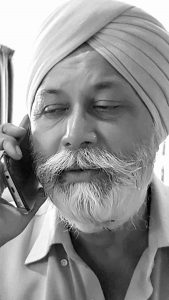
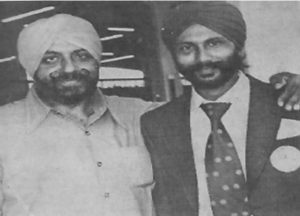
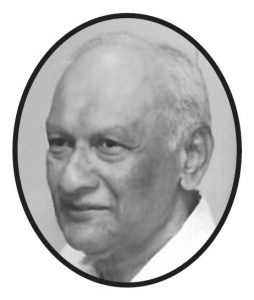
Right: Semret with his dad Genda

As for prize money winnings, and the personal sponsorship, they did not mention the quantum I will receive, but were open for discussion after I signed the contract.
However, there was one paragraph that caught my eye and I was uncomfortable with it. It was regarding medical and clinical services which read: “We will provide the best and you will not question us.»
And I had to agree to all these terms and conditions without any being deleted or for further discussion.
As I stared at these words “medical and clinical services,” my thoughts took me back to November 27th, 1977 in my home in Ipoh with my Pitaji Genda Singh and how I ended up being involved in the hammer throw.My Pitaji, was the undisputed hammer throwing hero in our family and he had just returned after winning the bronze medal in the Kuala Lumpur SEA Games. He achieved this despite going against doctor’s advice as he was injured with a pectoral muscle tear.
All strapped with plasters on his chest, he called me and all my other siblings, brothers Kulwant Singh, Kaldip Singh, Manohor Singh, and Mahinderjit Singh and sister Persin Kaur together. He announced that this was his last competition internationally.
He then looked at us and said: “One of you will have to carry on where I left off.’’ It was more like an order, and he did not say which one of us.
There was silence among us siblings. We just looked at one another but no one said a word. As soon as we were out of earshot, all my siblings unanimously decided that I should be the chosen one. You have to carry on with the legacy as you are the eldest in the family.”A couple of days later after careful thought, I informed my Pitaji at lunchtime that I would continue where he left off. I was just 22 years of age and had never thrown a hammer as I was more a 400m runner.
My Pitaji beamed with delight and said: “Train with the right attitude and stay clean.”
My Pitaji’s words especially “stay clean” jolted me to the situation in Perth and the contract. So, when I met up with the talent scout I enquired:” ‘‘Does medical and clinical services mean I have to go on anabolic steroids?”
He was slient and I told him I cannot accept the offer although it was very tempting. He was surprised and never tried to change my mind.
As for me, the offer was too good to be true and I have had no regrets turning my back on a professional career. I continued to compete internationally until the 1989 SEA Games in Kuala Lumpur and thus fulfilling my Pitaji’s dream.

I Ran Away From Training

By
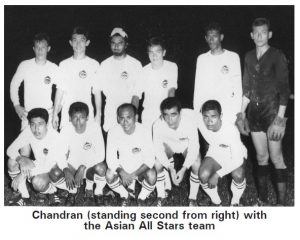
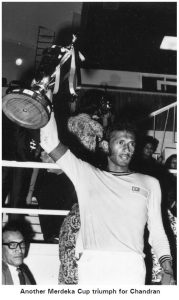
M.Chandran: I ran away from my first national training camp at Merdeka Stadium in August 1961!
I could not imagine this episode would be the start of a 12-year association with the country’s youth and national teams.
Looking back at that first call-up for the Asian Youth Under-20 football competition in Bangkok which was held the following year, I was just 18 years and very wet behind my ears. I was still in school when I was called up for training with 29 other players.
I was really excited but this excitement didn’t last long. In the first six days of my training, it vanished and I was devastated.
I never imagined that training as a football player could be so tough. I just couldn’t endure the sessions. It was torture. Physically and mentally, I just wasn’t able to take it.
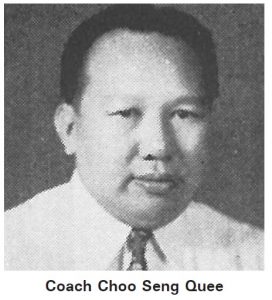
Uncle Choo Seng Quee was a no-nonsense coach, a real taskmaster. A big fella, standing over six feet, he put us through a punishing physical routine, something I had never experienced before. All I knew was how to play with a ball.
The weight training from 6.30am to 7.30am in the Merdeka Stadium carpark was something I wasn’t able to handle.
And immediately after breakfast I had to run off to school. On returning to camp in the afternoon, we had to undergo another one-hour fitness training. Again it was something I dreaded doing.
The only session I liked was when Uncle Choo put us through tactical training for 90 minutes on the Merdeka Stadium pitch in the evening. I enjoyed touching the ball more than all the physical endurance training.
On Monday, a week after being in camp and immediately after the morning session, without anyone noticing it, I packed my boots with my books and left for school – never to return to training camp. No one came looking for me.
I thought that this was the end of the road but in April 1962, I was recalled for the second phase of training. On reporting to Merdeka Stadium, Uncle Choo straightaway recognised me and remarked, “You ran away the last time. From now on you’ll sleep on the bunk next to me.”

From then on he kept a watchful eye on me. He was an excellent coach and was nice to all of us. However, when it came to training he was a disciplinarian.
He was a stickler, too, for punctuality at training sessions and his physical fitness regimen turned out well for us in competition. From him I learned that if you are very fit you are less likely to get injured.
I was again called up for the third phase and to my surprise, I was selected to represent Malaya in Bangkok in the Asian Youth tournament. In fact I played as a centre half in all the matches where we finished fourth overall.
My love affair with the national team started from here and I owe it to Uncle Choo. He was the one who put me on this path and I have great admiration for this man.
Footnote: Chandran captained the Malaysian team to the 1972 Munich Olympics, the one that Malaysia participated in. He was skipper of the 1974 Teheran Asian Games team which won the bronze medal for the first and only time in the Asiad series.

My Football Dream

By
M.Chandran: In my 13 – year international career, playing in the 1972 Olympic Games was without doubt, my greatest football dream come true. What this 1972 Malaysian team achieved is not only a first in the annals of Malaysian football, but it was something that has never been repeated.
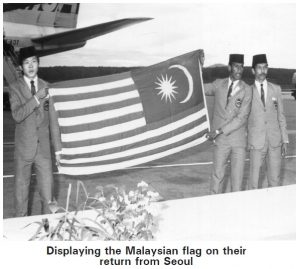
And this team did it in style. We qualified for the Games with an unbelievable victory over South Korea. It was not easy to beat the Koreans on their home ground in Seoul but we surprised them 1-0.
It was a very tough encounter and we qualified for the Olympic Games for the first time at the expense of the Koreans. You must not forget South Korea had competed in two previous Olympic Games (1948 & 1964).
For me and my teammates it was not only a great honour, but a dream come true to play in the Olympics.
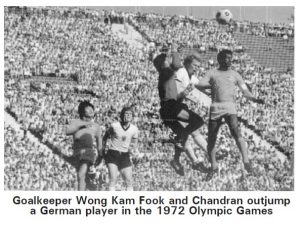
We faced Germany after the opening ceremony of the Olympic Games at the Munich Olympic Stadium on 27th August 1972, and despite losing 0-3, we put up a sterling performance.
For nearly 56 minutes we showed some brilliant ball play which had the Germans in awe. Until than we matched the bigger opponents by slowing down the pace of the game, which the well-oiled German team were unfamiliar with.

Our lack of knowedge of European style of play, and mental strength proved to be our downfall. When the Germans switched to their fast game, we were totally disorientated. The German resilience contributed to their victory.
We made amends two days later by beating USA 3-0 in the second match, but went down to Morocco 0-6, and were out of contention.
As a player, the appearance in the Olympic Games was the pinnacle of my career.
Two years later I led Malaysia to a bronze medal in the 1974 Teheran Asian Games. Again a feat, or rather a podium finish, that’s still unequalled.
It was the only time that Malaysia ever won a medal in the Asian Games football competition, and in that same year, after this victory, I called it a day. I quit, when I was still ahead.
(NOTE: M. Chandran was the captain of the 1972 Olympic and 1974 Asian Games teams).

MOST COMMENTED

Tunku In Tears!

A Humble Guy

- Advertisement -