Home Blog Page 16

Never To Crash Again!

By
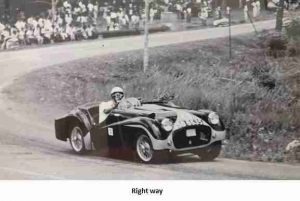
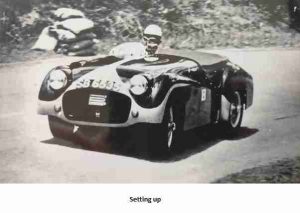
Eric Ooi: Chinese medicine made me a better driver. I started race driving way back in 1959, more than half a century ago. The TR2 was the first car I raced in.
The Singapore motor sport calendar that year had only two sprints and 1 hill climb if I remember rightly.
My first race was a sprint on a straight course. I came second behind an Ace Bristol.
The second event was the Gap hill climb.I was again second behind that Ace but this time I was very close behind and my time was one of the fastest for a TR2. I felt great and began to believe that I was the best.
The third event was over a twisty course and I was sure it would not be a problem.
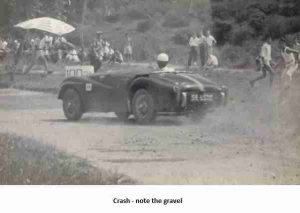
On the warm up lap I made the stupid mistake of going fast on an unfamiliar track. Over a crest into a tightening right hander I ended up well and truly off the road. One look at the front of my car and I knew it was going to be expensive, certainly much more than I could afford. I sat on the road beside my car and held my head.

I was trying to decide whether to kick myself or to cry.
It was then that Lim Peng Han came and sat beside me assured me the car could be fixed and that he would help get a good mechanic to do the job as a favour, cheaper but not free.
Lim Peng Han was an old hand at racing and taught me my first lesson. A fast entry into a corner looked spectacular and felt fast for the driver, but a quick clean exit was really the winning edge. He then mentioned some formula involving V and R .I was wondering what the hell he was talking about.

He said the formula simply meant that when cornering V and R vary directly where V is the speed and R is the radius of the turn. This simply meant that the speed round a turn is limited by the radius of the turn. To get a quick exit the trick was to enter the corner on a smaller radius i.e. slower and then to progressively increase R as you turn on the power before the apex.
I wish someone had told me this earlier.
The second lesson I learned was at home. And it was the lesson that really hit home.
My sister’s old servant a great believer in Chinese medicine said I must have been banged around a bit and could be hurt internally. So Chinese medicine. A big packet of stuff was put into a pot and boiled for hours.

As I watched the cauldron boil and bubble, I knew for sure I was in double trouble.
That night I had to drink a big bowl of the most foul tasting and evil smelling brew imaginable.
I swore I would never crash again and I never did. I made very sure I knew the track thoroughly, that I was fit and the car was double checked. The fear of Chinese medicine drove me to safety.
So you see Chinese medicine really works. Maybe the police should try this too for traffic offenders.

Anchorman saga

By
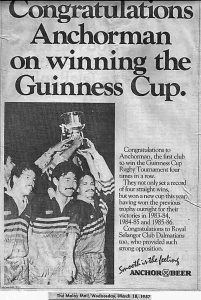
Hisham Rahman: Rugby stalwarts Shahid Majid, Ariff Omar and Kamaruddin Sulaiman who broke away from Cobra due to lack of playing first team rugby, decided to form a new team to compete in the Selangor league in 1974.
They managed to play under the banner of the PJ Club and became Selangor Anchor League champions and the Guinness Cup knockout champions in 1974.
After becoming champions, however, the PJ Club did not make good their promise to provide jerseys and balls. It was a sad experience indeed as their plans to represent the champion club of Selangor to compete in the All Blues tournament in Seremban was aborted due to lack of funds.
The club had to manage on its own, members stumped up their own money and the true spirit of togetherness was instilled.
That was the situation of sports generally those days when it was initiated and driven by members, dedication and love for the game. They only ask for balls and jerseys to play without any monetary benefits and yet they became champions!
CLUB X – 1976/77


During the transition period and without any sponsor support the Club participated in the SRU league and registered as Club X with ‘X’ as we know in our studies of mathematics in schools, denoting the unknown factor. The Club X became champions again in the Guinness Cup. This was noticed by a gentleman, Harun Ibrahim, and a director of Harga Industries, who was impressed watching Club X beat the RMAF Blackhawks as they fought back to win 10-9. He offered his company’s executive lounge as the base and provided the team with jerseys, stockings and balls. His generosity is till today appreciated by the team. At the same time Ahmad Mahmud, who was a sports officer with Universiti Kebangsaan, granted permission for the team to train at their field.
Players were recruited from school leavers, universities and colleges. Those from out of town and without jobs were assisted in finding employment.
Their hand work was realised and by then Club X had more than 40 players to choose from and managed to field two teams – one each in the Senior and Milsum leagues.
ANCHORMAN CLUB – 1977
About the same time Malayan Breweries Ltd or MBL, the manufacturer of Anchor beer, were heavily involved in sponsoring sports events ranging from darts to soccer to rubgy.
And the theme in their advertising campaign was the ‘ Anchorman’ — a faceless man, successful at his job, superb in his chosen sport and drinking his choice of beer.
This scribe played fullback for Club X and the national team. I was then the Anchor Draft Area Sales Manager, thought that the faceless Anchorman shared a similarity with the unknown Club X .
Also in rugby, the player in No 8 position as the link between the forwards and the three quarters, is aptly called the anchorman. I spoke to Lee Kee Hock, the general manager of MBL, and arranged for his colleague Loong Wei Hin to meet with Club X pioneers like Shahid Majid, Ariff Omar, Rosnan
Shafie and Halim Rahman and the Anchorman Club was born.
Finally, this one club which is successful on the rugby pitch, found its handwork noticed and
MBL undertook to meet all its financial and administrative responsibilities.
Since 1978 the Anchorman went on to win the International Penang 10s, beating the Australian Ferrets, became Guinness Cup champions again in 1979, beating the favourites Malaysian Police, and the Anchor League trophy, defeating RMAF Blackhawks.
1979 was indeed a memorable year for Anchorman as a club completed a treble by being champions in rugby, in cricket for the Navaratnam Shield and in football by being the Selangor State Under 16 champions.
Then in 1980 came the trophy they badly wanted, the Anchor Rugby League, a competition sponsored by their sponsor MBL. ANCHORMAN’S
CONTRIBUTION TO
RUGBY
Anchorman became a much respected club not only because of the people behind it, but because of their actions and achievements within a short space of time.
It is not surprising to see most of Anchorman players donning either national or state colours in their respective games. In fact, in 1980 at a time when Malaysian rugby found it difficult to beat the Thailand national team, the Malaysian squad which consisted of 11 players from Anchorman Club beat Thailand and that, too, in Bangkok.
The growth of rugby in the 1980s can be attributed to Anchorman as players that were recruited to play with them went back to their respective employers to start their own teams — Maybank, UMBC, Bandaraya Dragons, where Shahid Majid, Chong Chang Kiang and Wak Yassin Said respectively were instrumental in getting things going, to name a few.
However, when the pioneers of Anchorman established the KL Rugby Union, most of them regrouped and KL became a rugby powerhouse winning for them the pinnacle of Malaysian rugby – the HMS Malaya Cup and the Agong Cup. The Anchorman were also good organisers as their members successfully organised the historic Crescent Cup Rugby Championship 2015 in Malacca, a first of its kind in the world for the rugby playing Islamic nations under the Organization of Islamic Conference.
PASS IT BACK Presently, the pioneers of Anchorman are actively involved in rugby in one way or another. Nik Azmi is the president of KL Rugby, an union which Anchorman is instrumental in setting up. Rahman Khalid and Nasser Jumat have successfully registered the Club with the ROC and are the president and vice president respectively.
There are Anchormen in Johor Baru, Ipoh and KL actively into rugby at grassroots. In fact, in October 2017 an Anchorman Under 12 team sponsored by our own T Putra Harun Jumat from JB won an international U12 competition in Singapore.
This scirbe also became the first Malaysian to be elected to the executive council of Asia Rugby where he served for two terms (2011-14) and brought the 15s Asian Rugby Championship to the PJ Stadium to provide rugby fans starved of watching Malaysia play an International 15s game among other Asian national teams.
Thanks to the game of golf, pioneers still find time to recall the good old days. The rest as they say is history and we are glad to be a part of it. Thank you, all Anchorman who made it all possible.

Cheers!

A Captain Lays It On The Line

By
N.Sri Shanmuganathan: The national hockey team to the 1973 World Cup in Amsterdam performed disastrously, finishing second last. On returning to Malaysia, I resigned the captaincy of the team.
I was subsequently selected for the Christchurch International in New Zealand in 1973 and also for the 1974 Teheran Asian Games.
Goalkeeper Khairuddin Zainal was the captain of the team to the Teheran Asiad. On the team’s arrival in Teheran, Khairuddin was unable to play and since there was no vice-captain, there was no one to lead the team.
Team manager Dato’ Manaf Ibrahim called on me to lead the team but I turned it down and suggested that other senior players be given the role. For reasons unknown there was no captain to lead the team.
Everything seemed al right until in the bus to the first match in the Teheran Games, the manager approached me to lead the team. Seeing the situation I agreed to lead the team and told him that the moment we left Teheran I would cease to be vice-captain. And if he was agreeable to that, I would accept to lead the team.
In the event, Malaysia won the bronze medal in the Teheran Asian Games. The previous occasion in the Asiad series that Malaysia won the hockey bronze was at the 1962 Jakarta Games.

On the way back from Teheran, we had a stopover in Colombo. Our paternal promoter of national hockey, Tan Sri Azlan Shah, too, was on the same flight as us. He requested I sit next to him on the journey from Colombo.
He said he wanted me to be captain of the Malaysian team and asked if there were any changes I wanted for the team. At that moment my mind flashed back to the 1968 Lahore International when I was dropped even before the trials. But on the eve of the trials another fulback, Tara Singh, was injured.
On the first day of the trials, when chief selector Tan Sri Raja Azlan Shah wanted to see Tara Singh in action, the latter could hardly walk. Azlan Shah saw there was no way Tara could go with the team to Lahore. I was to go instead. The irony is that the team management and selectors were willing to take an injured player in place of an upcoming one.
My feelings for Tan Sri Azlan Shah will always be that if not for him, I would not have played international hockey. I would perhaps have played cricket for the national team.
When Azlan Shah asked what it would take for me to accept the captaincy, without hesitation I suggested that coach Sidek Othman be replaced by Ho Koh Chye. Further, I requested that Franco De Cruz from Australia, A. Francis from Germany, Poon Fook Loke from London, and S. Balasingam, Phang Poh Meng and Harnahal Singh would be assets to the team. Tan Sri Azlan Shah agreed and that was how we had a formidable Malaysian side for the 1975 World Cup in Kuala Lumpur. Only Harnahal turned down the invitation.
When the final selection for the 1975 World Cup was made, my good friend sportswriter R. Nadeswaran asked me to predict our performance. I said we would finish in the top four.

The rest is history.

Politics 1 Sports 0

By
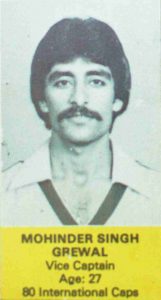
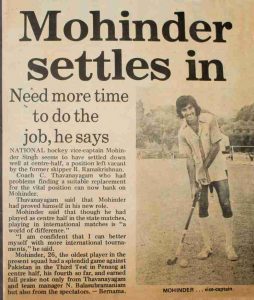
Mohindar Singh Grewal: Missing the 1980 Moscow Olympic Games was like a very bad dream. You want to erase it from your mind, but it keeps coming back
The hockey team had already qualified for this Olympic competition. My teammates were delighted to be representing Malaysia.
However, just about 11 weeks to go, our dream of being called “Olympians” was shattered by the Malaysian Government’s boycott of the Moscow Olympics. Malaysia had joined in the USA-led boycott.

My teammates and I felt totally let down and upset with this decision. There were so many unanswered questions… why was this happening to us? This was “politics” and we the sportsmen had to pay the price for it.


So disappointed was I, that I refused to keep any news clippings relating to the boycott and Moscow Olympic hockey competition.
If not for the boycott that would have been my second Olympic appearance after the 1976 Montreal Games. It would also have been the last time I would have made it, as age was catching up on me.
We had put in four years of hard work, dedication and discipline just preparing for Moscow. The pain and sacrifice we had endured to make our country proud did not matter to the decision-making politicians.
Sports should be above politics, but it was not to be for some people who used us for their political image.
It is very frustrating to an athlete whose greatest dream is to play in the Olympic Games.
Missing the Moscow Olympics will always be that nagging thorn at my side.

Rats Got My Berg!

By
Khairuddin Zainal: I made my international debut against Germany with a pair of borrowed canvas goalkeeper’s pads in the 1969 Pakistan International Hockey tournament in Lahore.
In this match I made such an impression by keeping the Germans from scoring, that Zain Azahari, the team manager decided to let me play the rest of the tournament although I was the reserve keeper to Leong Whey Phew.
Throughout the duration of this event, the borrowed pads from my club, TPCA, stood the test from the onslaught of some of the world’s hardest hitters of short corners.
When I look back to 1964 as a student of St. John’s Institution’ Kuala Lumpur, I was more of a footballer and had a keen interest in trying my hand as a hockey goalkeeper. But I was turned away by the hockey teacher who felt that I would not make it.
Though I never had the chance of meeting this teacher again after leaving school, I always wondered what he would have said if he knew that the boy he turned away became an international goalkeeper.


Hanging around TPCA Club, I was encouraged to try my hand at being a hockey goalkeeper. It was the late “Big” Shan (M.Shanmuganathan) who took me under his wing, while the late A.Arumugam gave me my first hockey stick in 1966.
After the Lahore tournament, I was gifted by Zain Azhari with a brand new keeper’s pads. It was the “Berg” pads from Germany, costing RM500 and it was top of the range which was used by all the leading keepers in the world. It was also the first of its kind in Malaysia.
Never having one of my own before, I not only took special care but maintained the pads with special care. It had to be painted daily to keep it dry and light. It came with sewing needles and thread and whenever there was a tear or the buckle came loose, I will stitch them back
I remember someone telling me that if I looked after my equipment well, it will serve you well.
How true this was as I wore these pads from 1970 until 1976 when I played for the national team and later in veterans tournaments until the 1982 Tasmanian Veterans tournament.
Alas I lost them to some Malaysian rats who made their home in my “Berg” pads and destroyed them by gnawing into it.

Me And My Whistle

By
G.Vijayanathan: Hockey had always been my number one sport but after playing the game for a continuous period of 32 years for the Tamilians’ Physical Culture Association (T.P.C.A.), that I realised I wasn’t going to get anywhere, and decided to take up umpiring.
My initial registration as an umpire was as a Grade Three umpire with the Malaysian Hockey Federation (M.H.F.) Umpire’s Board on March 15, 1964. My first major tournament was the Government Services Hockey Competition which was held in Kuala Lumpur from July 17 -19, 1964. Although it was my first major tournament, I had the distinction of umpiring the final alongside S. Kathiravale.
My rise in international umpiring:
I had the opportunity to umpire at the International Hockey Tournament in Ahmedabad in 1962 where I had accompanied the Malaysian team as the Secretary. They were short of umpires. Unfortunately, our manager Dr. Aziz Durairatnam did not give his approval. He was not happy with the way Mr. P. Nagarvallah (Chief Organiser of the Tournament) treated the Malaysian team.
All the umpires who officiated at the tournament were confirmed as F.I.H. Class one International umpires by Mr. Rene Frank, the President of F.I.H. who was present at the tournament. What a great honour it would have been for me and Malaya (then)
The Asian Games, Bangkok, 1966:
Due to the uncertainty of Malaysia’s participation and the insistency of the host that only international class One umpires would be invited to officiate, the umpires’ board could not bid to send an umpire with the national team.
However, during the M.H.F. executive meeting the matter was brought up and the president (Tun Abdul Razak) suggested that as I was accompanying the Malaysian contingent as assistant manager, I should be appointed as the Malaysian official umpire to take my chances there. As luck would have it, the organisers were short of the required number and I had the opportunity of umpiring some matches, thanks to the foresight of our former Prime Minister and President of MHF, Tun Abdul Razak
1970 Asian Games, Bangkok, Thailand:
Lee Cheng Poh and I officiated at the Games. Although it was the first time I was to officiate at the Asian Games as an International Class One umpire, I had the honour and privilege of umpiring the final between India and Pakistan together with Ramalingam of Singapore.
The normal time finished with an exhibition of club standard hockey and the game went into extra time. There was no score in the first half of extra time. In the second period of extra time, India was awarded a short corner and there was a strong feeling that India’s chance had come. However, the hit-out was penalised for sticks and soon after Rashid scored the winning goal for Pakistan.
Jimmy Nagarwala, a top Indian hockey official paid glowing tribute to my umpiring in the final when he said, “In my 20 years of watching Pakistan and India play, I have not seen such a well contested, clean game.”
Revised List of Grade One International Umpires:
The International Hockey Federation (FIH) revised the list of Grade One International umpires at their meeting in Brussels in March 1971. Only Grade One umpires were permitted to officiate at the Olympic Games and those for Munich were selected at the FIH meeting held in October. Besides Pakistan which had 13, the other Asian countries like India had eight, Japan (4), Korea (1), Singapore (1) and I was the sole Malaysian Grade One Umpire.
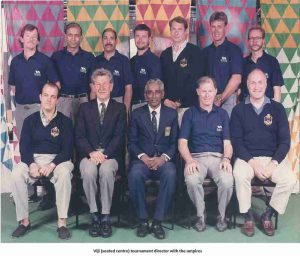
Munich Olympic Games – (August 27 to September 9, 1972
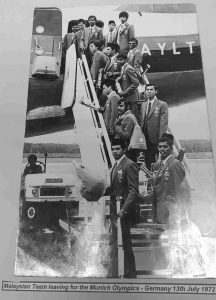
I was appointed by the F.I.H. to officiate as an umpire at the Munich Olympic Games. Twenty-eight umpires were selected for the tournament. The Asian umpires came from Pakistan (3), India (3), Korea (l), Singapore (l), Japan (1) and I represented Malaysia.
A bitter experience: – On September 8, 1972, I umpired the semi-final between West Germany and Netherlands. West Germany beat Netherlands 3 – 0 to qualify for the final against Pakistan who beat India 2 – 0 in the second semi-final. At least 15,000 spectators witnessed the semi-finals, 11,000 in the stadium and another 4,000 on hills nearby.
At the end of the day, the technical officials for the final between Pakistan and Germany were announced. I was thrilled to be nominated as one of the umpires together with Servetto Horacio from Argentina. Unfortunately, my elation was short-lived.
German officials had approached F.I.H. President, Rene Frank and asked him to replace me. They claimed that I was an Asian and therefore should not umpire as an Asian team was involved. I was summoned by the President who told me about the objection and diplomatically withdrew my name from the list. In my place, he appointed Richard Jewell of Australia.
“Sometimes it still feels unreal that within a couple of months, I am an Olympian and umpiring at the Olympic Games.
“The feelings of excitement for the Olympic experience are just as real to the officials as they are to the athletes participating, in the games. It’s an opportunity of a life time that doesn’t come around very often.”
NEW STRAITS TIMES (November 28, 1972.
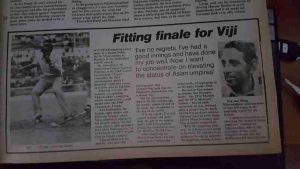
VIJI No: 1 in the World
High praise for Malaysian umpire.

G. VIJAYANATHAN of Malaysia is rated No: 1 hockey
umpire in the world. World Hockey, the official magazine of the International Hockey Federation, commenting on the umpiring at the Olympic Games in Munich, says: “The man generally recognised to be the best umpire was the young Malaysian, Vijayanathan.
“High praise indeed, considering that there were 29 international Grade One umpires from all over the world in the Olympic pool”.
2nd World Cup Amsterdam (August 24 to September 2, 1973)
The second World Cup was staged in the Amsterdam suburb of Amstelveen. I umpired the semi-final between Netherlands and Germany on August 31. What a coincidence it was with Malaysia celebrating Merdeka.
The match went to five periods of extra-time without either being able to score. For the first time in the crucial stages of a major competition, a penalty stroke competition was necessary. Holland won the penalty stroke competition 4 – 2 and qualified to meet India who downed Pakistan 1 – 0 in the second semi-final to avenge its defeat at the hands of the Pakistanis in the 1971 semi-finals. It was undoubtedly a memorable game and the cheers at the end could be described as a “lions roar.”
It was a pleasant surprise when I was told that the President (Rene Frank) had decided that the best umpires must officiate regardless of whether they were from Asia or Europe. That was how I got to be appointed to umpire the final together with Horacio.
It was a superb final with a wonderful and knowledgeable Dutch crowd. I had only one problem with the Dutchman Paul Litjens, known as one of the world’s best full backs. He had the habit of passing remarks at practically most of the decisions given against the Dutch even if it was on the opposite side of the field. After a severe warning, there was never a murmur from him after that.
However, India lost on penalty strokes and the Netherlands became hockey’s new World Champions. also rose to number one in the world rankings followed by India, Pakistan and West Germany.
As both Horatio and I walked back from across the field towards the main stadium after signing the match sheet, the entire crowd gave us a ‘standing ovation’ which I had never experienced before. It only went to prove how much the crowd enjoyed the game and appreciated our umpiring.
The 3rd World Cup, Kuala Lumpur(March 1 – 15, 1975)
Apart from being the organising secretary of the prestigious World Cup Hockey Tournament, I was included in the panel of umpires. There were 20 umpires in the panel and the other Malaysian umpire was none other than S. Kathiravale.
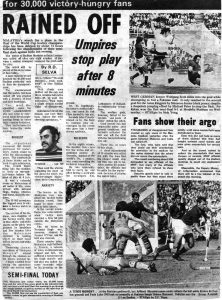
Great Honour: It was indeed a great honour for me to have been selected to umpire the final between India and Pakistan – two Asian giants on home ground in front of an estimated 50,000 spectators.
Much has been said and spoken until this day about the winning goal scored by Ashok Kumar of India. The Indians shrugged off a one-goal deficit at half time, turning on a dazzling attack particularly after Samiullah left the field (having hurt his collar bone) and finally won the game 2 – 1.
Islahuddin (captain of Pakistan team) has released a book – “DASH” written by him. In his book under a chapter “A Goal That Wasn’t”, he claims that the umpire had wrongly awarded the goal. Furthermore, Islahuddin has claimed he was the closest to the action and saw exactly what had happened.
In pictures of Ashok Kumar’s goal, one can clearly see nine players and myself, but Islahuddin is nowhere to be seen. Yet, he continues to make a false claim that he was closest to the action. Photographs and Videos do not lie.
Immediately after the match, a member of our organising committee, C. Thavanayagam saw a Pakistani official trying to hit down the pegs which were used to stop the goal boards (at the back of the goal posts) from moving. In actual fact the ball hit one of the pegs inside the goal and rebounded and did not hit the front upright as claimed by Islahuddin.

Moaning about Umpires;
I am sure every team and player around the world can relate to this point, A lot of players struggle with umpiring, but we often forget that the umpires’ decision is not something that one can control. Sometimes players blame umpires for one mistake which determine the game and players forget that they probably made several mistakes in the game which could have changed the game. Frustration with umpires is a mental battle and was something I had to learn how to control before I could reach higher levels in my own hockey career.
21st Olympics: Montreal, Canada, 1 976:
Raja Azlan Shah on returning from one of his overseas tours after attending an FIH meeting told me that I was selected to officiate at the Montreal Olympics. I umpired the semi-final between New Zealand and Netherlands which New Zealand won 2 – 1 and qualified to play Australia who had beaten Pakistan 2 – 1 in the other semi-final. Under the circumstances, I was hoping to get the opportunity to umpire the finals as no Asian country was involved.My dream and aspirations were shattered when A.I.S. Dara (who had a great influence with F.I.H.) insisted that the match between Pakistan and Netherlands for bronze medal must have an Asian umpire. He would have nobody else but me. The stadium was crammed to capacity for this match and Pakistan beat Netherlands 3 – 2 being tied 1 – 1 at half time.

1st Inter-Continental Cup – Rome.(September 22 to October 2 1977
The Inter-Continental Cup was staged for the first time in Rome marking an important land mark in the history of F. I. H.This tournament gave me the opportunity to officiate with some junior umpires who were officiating in a major tournament for the first time. All-in-all, I enjoyed my umpiring at the Inter-Continental Games, Rome
4th World Cup, Buenos Aires(March 18 to April 2, l978)
A total of 19 umpires were selected for this tournament. Only three umpires were from Asia – one each from India, Pakistan and Malaysia. At this World Cup, I umpired one of the semi-finals between Australia and the Netherland, which the later won 3 – 2.
Horatio Servetto (Argentina) was given the honour of umpiring the final in front of a home crowd together with Gillet of France.
The Champions Trophy – Super World Cup, Lahore, Pakistan(November 17 – 24, 1978)
The Pakistan Hockey Federation, aided by generous support from Pakistan International Airline (PIA) took responsibility for staging the first tournament in Lahore.
The final match: The final match would determine the first holder of the Champions Trophy. A draw would give Pakistan the title while Australia had to win. I had the honour of umpiring this game. Nearly 20,000 people watched this game, including President General Mohammad Zia-ul-Haq and several of the countries top personalities. The weather was splendid, and the match was telecast throughout the country. Pakistan beat Australia 2 – 1.
Honoured by the President of Pakistan – Gen. Zia-ul-Haq, 1979.
During the prize giving ceremony, General Zia-ul-Haq shook hands with me andcongratulated me and said, “You had umpired magnificently and I shall send you my personal present.”
That night, the President sent a carpet to my hotel and I took it as the personal gift that he had mentioned.
In March, 1979, the President sent through the Pakistan High Commissioner to Malaysia, Maj. Gen. Mohammad Rahim Khan a glittering gold medal with the emblem of the Pakistan Government. The gold medal also had the emblem of the Champions Trophy on one side and my name inscribed on the edge of the medal – which was the size of a fifty- cent coin.
Netherlands Hockey Association – 1979:
In 1979, the Netherlands Hockey Association organised a series of matches against Pakistan known as the “Peugeot Series.” Four World Class/Olympic umpires, namely Graham Nash (England), Santiago Deo (Spain), Alan Renaud (France) and I were selected and invited with the approval of F.I.H. We were housed in the best hotel, each occupying a single room. The Dutch hockey officials took us out every night to dine in some of the top restaurants.On a rough calculation considering the number of matches each umpire officiated, one minute my time umpiring would have cost about RM120/-. It certainly was an honour to have been selected to officiate.

Lopsided Selections

By
Franco De Cruz: 
There were parallels between the 1972 Munich Olympics and the 1975 World Cup teams. By that I mean, only the chosen 13 or 14 players in both teams played throughout the tournaments.
In the 1972 Munich squad, we had two goalkeepers, three fullbacks, four halfbacks, and nine forwards. We had an excess of forwards. Sadly, in spite of injuries to regular forwards, the reserves being four could not be called upon as replacements.
This was due to the structure and system of our play. I must say it was with disappointment that some of us had to struggle on, and continue playing in the competitions despite severe pain from injury.
In the Munich Games, we had achieved the best results in comparison to other Malaysian Olympics teams that had participated in past Games. But, if the selection process had been based on versatility of players, the results may have been better than they were.
At Munich, we were very close to qualifying for the semi-finals, and this was achieved in spite of playing with players carrying injuries. Can one imagine if we had the advantage of versatile replacements?


In the 1975 World Cup squad, we had two goalkeepers, three fullbacks, six halfbacks, and five forwards. During competition, the team was affected by injuries. We had three players off the field, and one being a forward, resulted in the coach having to improvise, and utilise one of the halfbacks as a replacement forward.
It was unfortunate that injuries did play a big part, mainly towards the later stages of the competition. The demands on the regular 13/14 players who were required to play constantly were physically too much. This was evident when we went to extra-time against India in the semi-finals and when we played in the third/fourth placing match against Germany.

My Love For Hockey

By
Franco De Cruz: My introduction to hockey began when I was seven years old. On my 7th
birthday, I was presented a miniature hockey stick. Wth this gift and on that very same evening I went off to play hockey in a little makeshift pitch with guys much older than I.
Not long after we started playing, someone stepped on my precious gift and broke it. With broken stick in hand, followed by a solicitous elder brother, I ran back home in tears.
My elder brother suggested to my mum that if he could cut off a branch of the guava (jambu) tree, an ‘L’ shaped branch of course, that would replace the broken stick. My mum insisted we wait for my dad to return home from work. When he did he cut off an ‘L’ shaped branch, and with this in hand I went off to play once again. What would we do without improvisation!

From this early introduction, my interest in the game grew and I went on to play hockey for the school team, the state combined schools team, clubs, the state of Negri Sembilan, Malaysian Police and, finally, the national team.

It is with pride I can say that I achieved my ultimate goal: wearing the national colours.
This was not achieved on my own. I was guided and groomed, in my opinion, by the very best of coaches. He is none other than Lawrence van Huizen. He had the ability to spot talent. He also had the knack of enhancing this talent and leveraging it to achieving the best. He instilled in me discipline, dedication, confidence, and most of all, humility. He was that one inspiration that made the player and person I am today. A ‘no nonsense’ guy.


I also like to pay tribute to all the other coaches and players who contributed to my game. The likes of the late Henry Sta Maria, M Joseph, Dato’ Yoges and Ho Koh Chye. Yoges told me after one training session: “Franco you have got tremendous skills, use it. Don’t allow bullying to put you off your game. Opposition players will do this, using rough tactics. Don’t ever lose your temper, but further annoy them as they can’t get the ball off you.” He made me think, I followed his advice, and it paid off.
Through hockey I learnt a great deal. Making loads of friends, travelling to various countries, and this greatly contributed to me being an understanding person. What experience I learnt through knowledge I acquired in the field of hockey I put this into practice in my professional life. It certainly made me the person I am today.

I immigrated to Sydney, Australia, in 1973, after playing for Malaysia in the World Cup held in Amsterdam. There I played club hockey for Moorbank Liverpool, and represented New South Wales at the national championships in 1974, held in Adelaide.

Toddy Goal Does It!

By
Thavanayagam: In 1961 I left Seremban, my hometown, for Kuala Lumpur after having secured a job with the Ministry of Health. As hockey was my first love I was very eager to continue playing the game.
I met a fine gentleman, Michael Lourdes, older brother of Olympian Michael Arulraj. He was then playing for and managing the Selangor Indian Association team which participated in the Division One League of the Selangor Hockey Association. I began playing for SIA from 1961.
We were not a team of stars but a determined and committed lot who sacrificed our Sundays mowing the grass pitch of SIA at Kampung Attap. We did fairly well and even upset kingpins Kilat Club that boasted the Shepherdson brothers–Mike, Christie and Dennis.
In 1963, I was watching an inter-state game when Dato Chet Singh, the then president of SHA, informed me that I had been selected to represent Selangor in the forthcoming Malaysia Day quadrangular to be played at the Mindef Stadium.
I was pleasantly surprised as the Selangor team was made up of virtually the Malaysian side, notably M. Shanmuganathan, Michael Arulraj, M. Doraisamy, A. Sabapathy and C. Paramalingam.
On Friday and Saturday, I played both matches beating Perak and the Armed Forces. After the game I went to the men’s toilet at the stadium where I met S. Selvarajah, brother of Olympian S. Balasingam, who was in the Selangor squad. Selva told me that I would probably be dropped for the final game against Singapore as the selectors wanted to field a more experienced player.


On Sunday morning, together with some friends from SIA, we went to Banting to attend the wedding of one of our players, Mokhtar Ahmad. After the wedding, someone suggested we taste some Banting toddy which was noted to be the best in Malaysia.
Convinced that I was not playing that evening I had a glass or two of the white liquid. I returned to Kuala Lumpur and had a rest before leaving for the Mindef Stadium at about 4pm on my trusted Raleigh bicycle.
On arrival at the stadium, I parked my bicycle and entered the stadium. There was M. Shanmuganathan or Big Shan as he was known, frantically waving a Selangor jersey and shouting at me to hurry-up. I ran up and he gave the jersey and asked me why I was late. I meekly told him I thought I was not playing.
Anyway I took the field and it was an exciting game. The Singapore XI were a formidable team comprising the likes of Anwarul Haq, Hon Yoon, Chong Beng, Kanagalingam, Kartar Singh and Douglas Nunis. At the interval the score was 1-1 and all the while I could hear the toddy shaking in my stomach! I was running all over the field and the toddy gave me a lot of extra energy.

In the dying moments of the second half, Selangor was awarded a long corner and M. Shan trapped the ball on top of the circle and slammed it towards goal. Anwarul Haq padded it. I came running in and scooped the ball to the roof of the net, thereby scoring the winning goal.

We emerged champions. I collected the gold medal and without a whimper got on to my bicycle and rode into the sunset. I dedicated the win to all toddy drinkers, young and old.


My Mentor, Freddy!

By
C.Paramalingam: If there was one person who was responsible for seeing my hockey career flourish, it is none other than Freddy Vias.
I had already appeared for Perak as a 19-year-old schoolboy in 1954. In late 1955 as a second year Technical College student on a field training course in Johor , I came in touch with Freddy and Aminullah Karim, both of whom represented Malaya in the Melbourne Olympic Games in 1956.
Freddy was a wealth of hockey knowledge and he imparted this to all who came in contact with him and I was one of them. As a youngster I thought I knew quite a bit about playing hockey until Freddy showed me a whole new world of how to play in an attacking position.
Hockey was just not all dribbling. How do you beat a six-foot defender like Freddy who also had the reach? And he was no timid defender. He was fierce and could put you out of action with just one strike.
He told me that almost all defenders are flat-footed and you should study them to see on which side to beat them on the run on. As a centre-forward he told me: ‘‘Don’t run blindly into them. Draw them towards you and deceive them with a feint.”
To frustrate the defender taking a free hit, he told me I should stand five yards in front of him. This will irritate him and he will intentionally undercut the ball which would be an offence and it will be a free hit to you.


He demonstrated to me the wrist shot, which you acquire as a cricketer and comes in very handy in front of the goalmouth. It’s an effortless motion but very effective.
There was the flat shot, punch shot, and the deflection shot. He showed me how to run from behind inside the opponents’ goal area and deflect the ball past the defence. The Indians and Pakistanis were very adept with this move.
The flick was another move I studied from him. It was to draw the goalkeeper out and on the run flick the ball into goal.
I just absorbed everything that Freddy showed me, the techniques, the positioning, running into space. What a teacher he was and a very unselfish one too.
In that single year I was in Johor, I had the greatest opportunity of being in the midst of this giant of a man. Every weekend I would follow him to play for Ceylon Sports Club in the Singapore League and utilised all that I had learnt from him.


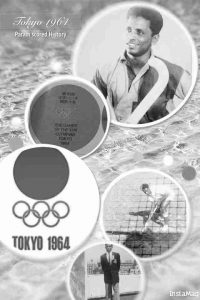
After returning to Selangor, I was selected for Malaya for some “Test Series” against Singapore in 1957 and this was the stepping stone as I went on to wear national colours in the 1958 Tokyo Asian Games, the 1960 International Ahmedabad tournament in India, the 1961 Hong Kong International Tournament, the 1962 Jakarta Asian Games which climaxed with the 1964 Tokyo Olympic Games.
My greatest glory was the Tokyo Olympics where I scored eight goals in nine matches and I dedicated this achievement to Freddy.
I shall always cherish and remember Freddy. He was not only a great athlete but also one of the best fullbacks I’ve played with and against. He was not only a class of his own, he was a man with a big and generous heart. It was all his training that gave me the privilege of playing for my country.

MOST COMMENTED

The Trails Blazers

Oh! What a Letdown!

A Golf Poet

- Advertisement -