Home Blog Page 17

The Unkind Cut

By
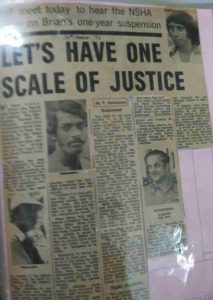
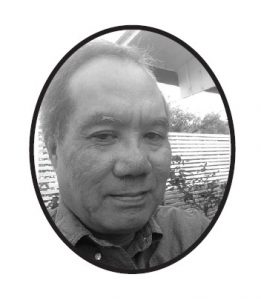
Brian Sta Maria: My involvement in hockey started during my early schooling at St. Paul’s Institution, Seremban. From the beginning I was blessed with having the best coach anyone could ask for.

Lawrence van Huizen, a tough no-nonsense disciplinarian, took me under his wing and together with additional encouragement and support from people like William Fidelis, Franco de Cruz, Michael Yan, my eldest brother, the late Henry Sta Maria, and a host of other ex-internationals like the late Ho Koh Chye and R. Yogeswaran, I picked up the finer points of the game.
In my first year of centralised training for the 1970 Asian Games, the usual ragging was compulsory (nothing as bad as nowadays), but I was protected by M. Mahendran. During the army training camp, the courage building exercise required the players to jump off the 3-metre platform into the pool and only Sri Shan refused. You’ll have to ask him why?


During the early years of training, coach Lawrence would always pair me with Franco during the defence versus forward sessions. I hated it because Franco was so skilful he made me run in circles. Disheartened and out of curiosity, I asked Lawrence why he always paired me with Franco. His answer made me realise the significance of this training. He said: “If you can stop Franco, you will be able to stop anyone.” How right he was!
As a fullback I had to be good at taking and defending short corners. We all know the speed and accuracy of Sri Shan and A. Francis, my teammates during much of my international career.


At practice, when Sri Shan takes the hits, Francis covers the goalkeeper’s right post and I cover the left post. And what was Shan’s favourite angle? You guessed it – the left post.
Vice versa when Francis took the hits. I had to switch to cover the right post. And where did Francis send his power shots? The right post.

But when it was my turn to take the hits, the one person who shivered was S. Balasingam. No, not because of my power hits but somehow or rather, the ball tended to hit Bala on some part of his body. Bala, my apologies.
Because of my fear of getting injured during short corner sessions, I practised my short sprints until I was the fastest off the block and I suppose coach Ho Koh Chye agreed.

I had to be drugged to get into the national team. At my first call-up to the national centralised training in 1969/1970, I wore my hair long and was told to have a haircut which I was not going to do. My friends knowing that it would end my hockey career even before it had started, spiked my drink. The next thing I knew they had cut my hair themselves. To them, my thanks for believing in me.


Life with my papi, Ishtiaq Mobarak

By
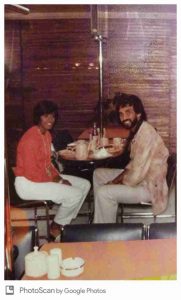
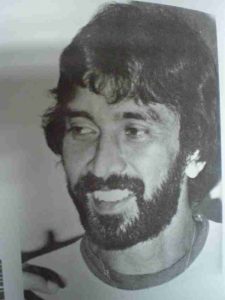
Shaniz Mobarak: Growing up in a loving family, having the parents that I have and being brought up with a whole lot of love to go around, I would say it was filled with incredible adventures. Both Mummy and Daddy, who are our true blessings have been with my sister Shakira and I very step of the way, teaching and guiding us through every moment in our lives.
Papi loved the outdoors, he always had a way of making an ordinary day an exciting one. So, it was only natural that we were always outside with him exploring every moment possible.
He always had a way of explaining and letting me try something new. He would first show me the basics, and then let me try and venture on my own. Once I had got the hang of it, he would teach me techniques on how to improve, and in a way that I could make it my own.

He always supported what I did and was a step away to catch me when I fell, like in my first bicycle ride. I remembered it was late in the evening, Papi had just got back from work and he had bought me my first bicycle with training wheels. I was so excited I insisted on trying it out. He showed where sit, where to put my feet and how to use the brakes. He then got me on it, held my seat and gave me a light push to start off.
After few paddles, he let go and I was on my way. Excitedly I pedalled so fast that I got to the end of the street, and instead of braking as I should have, I turned the handle fast round the corner, and went crashing down. Papi ran to me, picked me up, wiped my knee, and asked if I was okay. I was okay but I was crying. Then he calmed me down and explained what I did that caused the fall.
As a kid, I always had fond memories of when I would sit with Papi and we would have our conversations about anything and everything. This would happen throughout my childhood. He would always have his way of explaining how the world operates and how I should look at life more positively.
Papi and I always had similar moments that we could relate to. When I was two, I scared my grandparents to death. One morning when mum and papi were at work and my grandfather had to make a run to the market, I decided I would follow him. So I put on my shoe on my own, and followed him without telling my amma (grandmother). My appa (gandfather) was ahead of me, I assumed he knew I was tagging along behind. Amma assumed I was playing outside, and had not realised I was following my appa as he walked and turned right to head to the main road,
I was distracted by something and had turned left. Naturally I assumed he was ahead of me and kept on walking without fear. Amma, at that point had realised I was nowhere to be found and kept calling out for me, making the neighbours come out to ask what had happened.
The uncle from next door, without hesitation got into his car, and went on to look for me. As I was walking, a lady saw me and stopped me and asked where I was going and why I was alone. “I said I wasn’t alone. My appa is in front and I am following him to the market.”
As I was talking to the aunty, the neighbour uncle has spotted me and was worried as I was talking to a stranger. He stopped and called out and said: “Your amma is worried sick, where were you off to?” I said again, “I was following appa (grandpa) to the market.” He said, “appa has gone another way, let’s go home.”
The lady was suspicious and hesitant to trust my uncle, so she followed as uncle took me back. Amma and appa did not tell my parents till that evening, as they were shaken by it. But at the end, I found out that papi had done the same when he was two years old. Like father like daughter.


One of my fond memories was being in Maybank Bangi headquarters, where the track was our biggest playground. We loved it.
I especially loved the holidays, when Shakira and I would have our cousins (Kuhan & Kuilan) over. We were called the little mascots for the athletics team. Reason being is every morning like clockwork, we would get up and run out in our over-sized T-shirts that belonged to papi, to the track. We would lead the athletics team as we sang Negaraku before they started their morning training. In a single file we would stand proudly and tall in our over-sized jammies to sing the national anthem. After we were done, the athletes would start their workout and we would wander off playing, or attempting to train with the team.
One of my first attempts to hurdle was in Bangi as well. Papi exposed me to hurdles at a very young age. I would try the mini hurdle and also the regular sized hurdle (where it was placed down and tilt backwards in a triangle shaped) so it would be an easier height to clear for me. I had the best of times as it beat playing hopscotch.
Papi loved taking us to the pool as well. The same as teaching me how to ride a bicycle. At the beginning he got into the pool with Shak and I, teaching us the techniques of swimming.
How to swim, dive, float, sink, and do flips and even float. It didn’t take Shak and I long to catch up. After a while we were bored swimming in the shallow end. As we were rebels and little mischievous all the time, we were itching to swim at the deeper end of the pool. And so we did. Even the lifeguard couldn’t stop us. Because, even with Papi chilling by the pool, and reading his newspaper, he was always aware of where we were. So like gangsters we were the only kids swimming at the deep end.
Moving to Zoo View was one of the highlights of my childhood. Sister and I were the mini tomboys of our neighborhood. We lived on the hill, and right in front of our house was the jungle. Papi had spent time clearing a small part of the jungle for us to play. We would swing from the tree vines exactly like in the cartoon Tarzan. Papi will smoothen the ground as he had a set of golf clubs, and we would try to putt. We would have bonfires, roasting potatoes and have barbecues for every occasion.
Mummy and Papi ensured we had the full outdoor experience learning and exploring.
When I was 12 years old, after UPSR, mummy and papi had a serious discussion about my future. They asked me what I thought about joining Bukit Jalil Sports School. I hadn’t really thought about it.
“Papi, do you want me to give it a shot”? I asked him. I would need to qualify first, of course. And so we went for the open day trials. As it turned out, I qualified and so my journey started as an athlete.
Papi applied to be a coach in MSN, and we were the young troops of Bukit Jalil. Papi was in charge of the senior athletes at that point, as he was the national coach then. But after a year, he insisted on coaching the junior athletes, and so he started coaching my batch, and from then on my journey with Papi began as a coach and athlete.
For him, athletics wasn’t just about sports. For him it was about life and shaping one’s character and perception the many challenges that one will face. He would talk to us as a team, and at times individually. If I was having a bad day or was distracted, Papi could always sense it. He would always address it privately at the end of the session. He always cared for the well-being of his athletes, and would do all he could to help in any way possible.
During competition, Papi will ensure that he speaks to us reminding us of what we should do, our targets and techniques. He was always at the starting point to start his athletes off, and at the end of the race he would sit us down to explain what we did during the race, showing us how we could improve, and what we needed to focus on.
He always had time for us. He never favoured any of his athletes especially with me. When on track, I wasn’t his daughter, just one of his athletes. Papi taught me to believe in myself, to always fight for what I wanted and do what I loved. He taught me never to do something to impress others. He always told me to be strong, be the best version of myself, to always know my roots, be humble, and be kind to others.
The strongest memory of my childhood is filled with lessons that my father and mother bestowed upon me. Sometimes memories can take different versions when they related by different people in family gatherings.
A memory that belongs to me and has not been tainted by the different versions, was about me as a five-year-old girl, running into the waiting arms of my father when kindergarten ended. My dad was always at the gates of the school waiting for me. Not once was he ever late.


I remember our adventures to the Klang Gates Dam on Fridays or the weekends. Fortunately for me it was only a five-minute journey from my school. I remember walking along the gigantic water pipes. “Be careful” he would say to me, but never once did he discourage me from being adventurous. Passing by the kampung folks who were always happy and friendly, he would always greet them as if they were close friends. When we got to the fringe of the forest he would always let me lead the way. Can you imagine a five-year old happily marching through the forest with only one goal in mind, and that was to get to the river as soon as possible. As soon as we would reach the river, “splash” in I would go. I remember this one weekend our neighbour’s boys who were much older, followed us on our adventure to ‘the river. At five, you couldn’t comprehend fear the way you would when you were older. So when I climbed up a tree to jump into the river and said “your turn” to the boys, I couldn’t understand why they were afraid. He would never taunt the boys but always encouraged them.
Five years ago after my father passed away, I was feeling lost and disconnected to the life I had been living in the city. I was driving around while thinking about my father and found that I ended up at the parking spot near the river. I passed the water pipes that looked gigantic when I was five and I couldn’t believe how small it looked now. Slowly I drove past the kampung and arrived at the parking. As I made my way through the forest and to the river, all my memories as a child and my visits to the river came flowing back as easily as the river flows. I sat on a boulder that I used to jump off and just closed my eyes and took in the sounds of the river flowing, birds chirping, and crickets and cicada’s singing. I took in a deep breath and let the smell of nature fill my lungs as the wind caressed my skin and stoked my hair. I sat there and I relived the memories of my father.
My father had been grooming me to be courageous and to fully commit to any decisions I made and to always be aware of my surroundings. He had created such a strong bond between me and nature that I will always be grateful for.
He had always encouraged me to make my own decisions and constantly reminded me to be careful as I followed the path I had chosen. He encouraged me to be more, do more. He had taught me to never look down on others for their fears but instead help them to overcome them. He taught me to face my fears and I do that on a daily basis. Most of all, he taught me to love nature. To love Mother Nature and to respect Mother Nature.
“Do what you love and you will never work a day in your life,” he said to me once. Those words came floating through the trees, carried by the wind, I could almost hear him say it. Feeling renewed I left the Klang Gates Dam river knowing that my father had prepared me for my future. He had hidden important life lessons in every memory that I had of him. He had prepared me to go out, be adventurous and to always be kind and stay humble. To love and care for all. I will forever be grateful to have had a father who always encouraged me to be the best version of myself.
Papi devoted his time, love and passion to what he did. He would love being at the track, he was always the first and last to leave and never missed training unless he it there was a thunder storm,
Papi was a simple and humble man with no expectations, and everyone loved him and respect him. He was a loving family man. He lived a simple life. He appreciated everything that life had to offer, and never demanded for anything more. He was always to himself and never troubled anyone. We miss him dearly. We love you Papi.

An Old Cassette Tape

By
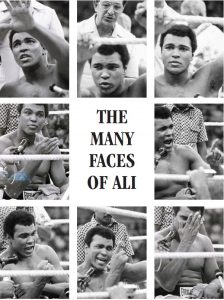
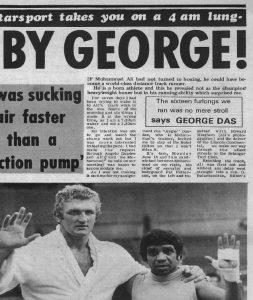
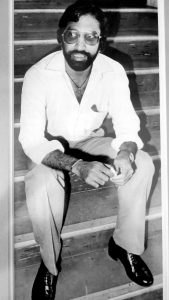
George Das: It’s an old cassette tape. In fact, It’s a tape I’ve recorded over and over many a time. Mostly it was to record country music aired over Radio Malaysia in the early seventies.This particular Cobalt C60 cassette tape means a great deal to me. Recorded over the country music is the voice of Muhammad Ali.
Many recordings of Ali are out there in the market but I suspect this is probably the only recording which has the three-time heavyweight boxing champion reciting poems.I was most fortunate to be there alone with him in the presidential suite of the Kuala Lumpur Hilton. Dawn had just broken on the Thursday of June 26th, 1975 and the No. 1 country song at that time was Don Williams’ “You’re my best Friend”.

In front of me was Ali, the biggest sporting icon the world had ever seen and how very fortunate I was to have this personal interaction with him.

Just a few hours earlier, I had trudged along with Ali on the uneven and heavy Selangor Turf Club track as he worked on his stamina and legs. After the workout, he invited me over to his suite as I hitched a ride with him in his limousine.

I had already planned for such an eventuality. So I was armed with my notebook and my sturdy and reliable National cassette player (unfortunately it’s no more in my possession).

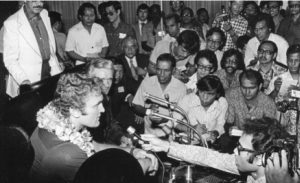
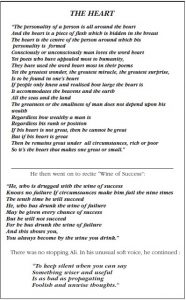
We talked about his upcoming fight with Joe Bugner for a while. He then stopped short and asked me, “Do you want to hear some poems?”  At first I was not keen but I was not in control of the situation.

Without an answer from me, he began to recite “The Heart” from a book. My cassette tape was still rolling and this is what I heard:

I must confess here, I was never a fan of Ali. I grew up hating his guts. He was a brash, bold,          arrogant and a showy boxer.

But on that day when I had the opportunity to be in close contact with him, I discovered the ‘real’ Ali. There was a certain magnetism about him.

He was a gentleman and very polite. No raised voices or harsh words spewed from the “Lousville Lip”. He was soft-spoken and you had to strain your ears to catch every word he spoke. This was when I found out that I was totally wrong about my earlier judgment of him in my 110- minute encounter with “The Greatest”.

Ali won numerours titles with his lightning fists and shuffles but he captured the world with his heart of gold. He transcended the sport. He was a sportsman and a legend. It was remarkable to watch him. He could turn a press conference into an event with his jokes and poems.

He had the grace, he had the charm and was a humble human being. Ali will also be remembered as a magnificent sportsman and a great showman.

Without a doubt, Ali was “The Greatest” sporting icon, a global sports personality and we’ll never see another like him ever!

Those memories of my encounter with Ali, who was bigger than life, are stored in this old cassette tape of 42 years ago.

By
George Das

A Rock Star Idol

By
George Das: In  Kuala Lumpur. Although his exceptional talent as a goalkeeper was already showing, he turned out as a striker for his alma mater in the under-18 team.

In fact he was spotted for his football flair as a 10 year-old forward by Master Francis Fernando of La Salle School Sentul at a primary inter-school match. He was then with a Chinese school.Fernando, who was the football teacher, saw his talent and requested his mother to transfer Chee Keong to La Salle Sentul.

Chee Keong honed his goalkeeping traits at La Salle Sentul under Master Fernando where Tony Francis also went to school with another schoolmate Christie Michael. Fernando, a dynamic sports teacher, will make Chee Keong play in goal and also as a centre-forward. He also trained him to be a sprinter and had the distinction of running just under 11 seconds in the 100 yards.

Christie Michael, who was Chee Keong’s teammate from La Salle School Sentul through to St John’s Institution, remembers this wonderful guy: “I was a left-winger. All I had to do was send the ball to Chee Keong, and he will put the finishing touches.”

“After he scores, without fail he’ll run up to me and hug me,” recalled Christie.

However in St. John’s, Chee Keong  hardly played between the“posts” for at 15 years of age, he was already in the school’s 1964 under-18 team. He was equally good at dribbling and so coach Major Mok Wai Kin deployed him in the attack.

“He terrorised the opposing defence with his footwork and it was a delight to watch him,” recalled Joseph Teng, a teammate from the St. John’s senior team. At the same time he was already representing the Malaysian Youth team appearing for them at the tender age of 13 and winning accolades as a talented goalkeeper.

He was just not a one sport sensation. Turning out for St. John’s at inter-schools competitions, he also excelled in athletics (100, 200 & 400 yards), and rugby. He was a fast wing half in rugby.

“Chee Keong was a sports protégé with exceptional talent. Though he was an excellent goalkeeper, he could have excelled in any sport,” commented A. Vaithilingam, a former Malaysian Schools Sports Council secretary.

Making his debut for Malaysia in the 1965 Merdeka Football Tournament at 15 and the youngest Malaysian to do so, he was the reserve keeper to Teh Cheng Lee but the following year he became the first choice and continued to appear for the country until 1970. He played alongside M. Chandran, N. Thanabalan, Ghani Minhat, M. Kuppan, M. Karathu, Soh Chin Aun, Santokh Singh, the Choe brothers Robert and Richard, and many others before turning professional in Hong Kong.

“I met him in 1963 when he was a reserve in the Selangor Malaysia Cup team and just a schoolboy,” was Chandran’s recollection.

He continued: “A very reliable keeper. We could play with confidence with him in goal and we could rely on him to be in control in any situation in the penalty area. He was good at diving for the ball from any position and also good in the air. He was no doubt the best goalkeeper we have ever had.”

Thanabalan, had some great moments with Chee Keong whom he described as “full of fun” and as one who was always playing pranks and jokes on the senior players but on the field he was a much disciplined person.

He told how opposing forwards were scared of going up into the air with Chee Keong.

“Great forwards like Indonesia’s Sujipto, Jacob Sihasali and Singaporeans Quah Kim Swee and Majid Ariff wouldn’t dare tangle with him lest they get hurt,” Thanabalan quipped.

At the 2017 Sports Flame function, where former sports personalities came together, Chee Keong and Thanabalan were overheard to sharing a joke about a two touch football.

“He kicked the ball into the opponents half. It bounced over the centre back and rolled towards goal. Before the opposing keeper could get to it, I pounced on it and scored. So we called it a two touch football.”

Arriving in Hong Kong in late 1970, Chee Keong became an overnight celebrity, a “football rock star.”

A black-belt karate exponent, he had the looks of something between Bruce Lee and Jackie Chan, and the fans revered this brilliant goalkeeper.

He  was dubbed “Crazy Sword” and “Asian Steel Gate.” He was getting paid  more than any other player in the Hong Kong league.

So popular was he that in one match where he appeared for South China FC in the mid-70s, he was flown into the middle of the Hong Kong Stadium which was filled to the brim with 20,000 spectators in a helicopter.

Tickets were sold out for  almost all matches he played during his stint with Rangers, South China, Tung Shin, Jardines and Caroliners from 1970 till 1982.

Chee Keong set the trend for many Malaysians turning professional in the Hong Kong league…Khoo Luen Khen, Chan Yong Chong, Wong Kam Fook, Chan


We had just entered the traditional Chinese dhobi shop at Number 6, Ipoh Road in Kuala Lumpur, and waiting for us inside was a cheerful Chow Chee Keong.

A pile of clothes all ironed and folded was stacked behind where he was sitting. It was a day in June 1973, when he had just  returned to his parents’ home during the off-season of the Hong Kong pro football league.

I was then with the STAR and  was tagging along with Tony Francis of New Straits Times to interview the international star keeper who was making waves in Hong Kong as a professional player. These visits to interview Chee Keong will continue throughout the 70s for me.

Chee Keong was two years our junior at St. John’s Institution in  Kuala Lumpur. Although his exceptional talent as a goalkeeper was already showing, he turned out as a striker for his alma mater in the under-18 team.

In fact he was spotted for his football flair as a 10 year-old forward by Master Francis Fernando of La Salle School Sentul at a primary inter-school match. He was then with a Chinese school.Fernando, who was the football teacher, saw his talent and requested his mother to transfer Chee Keong to La Salle Sentul.

Chee Keong honed his goalkeeping traits at La Salle Sentul under Master Fernando where Tony Francis also went to school with another schoolmate Christie Michael. Fernando, a dynamic sports teacher, will make Chee Keong play in goal and also as a centre-forward. He also trained him to be a sprinter and had the distinction of running just under 11 seconds in the 100 yards.

Christie Michael, who was Chee Keong’s teammate from La Salle School Sentul through to St John’s Institution, remembers this wonderful guy: “I was a left-winger. All I had to do was send the ball to Chee Keong, and he will put the finishing touches.”

“After he scores, without fail he’ll run up to me and hug me,” recalled Christie.

However in St. John’s, Chee Keong  hardly played between the“posts” for at 15 years of age, he was already in the school’s 1964 under-18 team. He was equally good at dribbling and so coach Major Mok Wai Kin deployed him in the attack.

“He terrorised the opposing defence with his footwork and it was a delight to watch him,” recalled Joseph Teng, a teammate from the St. John’s senior team. At the same time he was already representing the Malaysian Youth team appearing for them at the tender age of 13 and winning accolades as a talented goalkeeper.

He was just not a one sport sensation. Turning out for St. John’s at inter-schools competitions, he also excelled in athletics (100, 200 & 400 yards), and rugby. He was a fast wing half in rugby.

“Chee Keong was a sports protégé with exceptional talent. Though he was an excellent goalkeeper, he could have excelled in any sport,” commented A. Vaithilingam, a former Malaysian Schools Sports Council secretary.

Making his debut for Malaysia in the 1965 Merdeka Football Tournament at 15 and the youngest Malaysian to do so, he was the reserve keeper to Teh Cheng Lee but the following year he became the first choice and continued to appear for the country until 1970. He played alongside M. Chandran, N. Thanabalan, Ghani Minhat, M. Kuppan, M. Karathu, Soh Chin Aun, Santokh Singh, the Choe brothers Robert and Richard, and many others before turning professional in Hong Kong.

“I met him in 1963 when he was a reserve in the Selangor Malaysia Cup team and just a schoolboy,” was Chandran’s recollection.

He continued: “A very reliable keeper. We could play with confidence with him in goal and we could rely on him to be in control at any situation in the penalty area.He was good at diving for the ball from any position and also good in the air. He was no doubt the best goalkeeper we have ever had.”

Thanabalan, had some great moments with Chee Keong whom he describes as “full of fun” and as one who is always playing pranks and jokes on the senior players but on the field he was a much disciplined person. He told how opposing forwards were scared of going up into the air with Chee Keong.

“Great forwards like Indonesia’s Sujipto, Jacob Sihasali and Singaporeans Quah Kim Swee and Majid Ariff wouldn’t dare tangle with him lest they get hurt, Thanabalan quipped.

At the 2017 Sports Flame function, where former sports personalities came together, Chee Keong and Thanabalan were overheard to share a joke about a two touch football:” He kicked the ball into the opponents half. It bounced over the centre back and rolled towards goal. Before the opposing keeper could get to it, I pounced on it and scored.So we callit a two touch football.”

Arriving in Hong Kong in late 1970, Chee Keong became an overnight celebrity, a kind off “football rock star.”A black-belt karate exponent, he had the looks of something between Bruce Lee and Jackie Chan, and the fans revered this brilliant goalkeeper.He  was dubbed “Crazy Sword” and “Asian Steel Gate.” He was getting paidmore than any other player in the Hong Kong league.

So popular was he that in one match where he appeared for South China FC in the mid-70s, hewas flown into the middle of the Hong Kong Stadium which was filled to the brim with 20,000 spectators in a helicopter.

All matches he played for the various clubs from 1970 till 1982… Rangers, South China, Tung Shin, Jardines, and Caroliners match tickets would be sold out and it would leave largenumbers of fans ticketless and disappointed.

Chee Keong set the trend for many Malaysians turning professional in the Hong Kong league. ..Khoo Luen Khen, Chan Yong Chong, Wong Kam Fook, Chan Kok Leong, Fung Seng Meng, Yee Seng Choy, Lim Fung Kee, Wong Voon Leung, Lee Ah Kau, Yip Chee Keong and  for a brief spell even Wong Choon Wah and Soh Chin Aun.

For Lim Fung Kee, his memories go back to when he was a 13 – year-old student of Cochrane Road School and Chee Keong was 16.He watched him play in a Selangor League match: “He became my idol and inspired me to be a goalkeeper. I admired him,” said Fung Kee, who played for Malaysia in the 1972 Munich Olympic Games.

He never gave up playing for the Malaysian national team. He made a brief comeback for the 1981 Asian Cup in Kuwait… a comeback he was utterly disappointed till his death. Malaysia fared terribly and it was dubbed the “Kuwait Debacle.”

I remember him telling me that it was a nightmare. There was bitterness when he said: “There was only one reason why we fared so badly. The team that played in  Kuwait was never the one that the public was led to believe.

“There never was a team. Individual talent there was but if you think that all these made up a team, in the real sense of the word, you are badly mistaken.

According to Chee Keong the single biggest flaw in the team was “factionalism”, one born out of coach Karl Weigang’s error in playing favourites.” This was obvious right from the start of centralised training and it was allowed to fester in Kuwait. Weigang’s favourites were allowed to dictate everything, the pattern of play and even down to the final choice of players to be fielded.”

But apart from this only disappointment, Chee Keong’s nearly 18-year chequered football career had many memorable moments which overwhelm that final fling with the national team. He loved to talk about the few encounters he had facing Pele and his Santos team from Brazil. Pele found many a time he had difficulty penetrating the “Asian Steel Gate” Chee Keong.

And there was the time in 1972 when he faced the diminutive Brazilian forward Tostao and Cruzeiro. He thwarted Tostao from scoring a number of times in this encounter. After that match, Cruzeiro offered to sign him up and even get him a Brazilian citizenship.But Chee Keong declined the offer and told me that he will never give up being a Malaysian.

After his football career ended in 1982, he returned to Malaysia and took up golf. V. Nellan, one of Malaysia’s veteran pro golfers, recalled the day Chee Keong went to him for some lessons at the Seremban International Golf Club. “Among all the other sportsmen who had taken up this game, Chee Keong was the most talented. He had a knack for the game. I just had to show him once or twice, and he quickly picked it up,” Nellan recollected. “He would always talk to me about how to keep fit and food. Keep away from oily food,” he would say.

He quickly picked up the game and became a professional golfer in 1984. He played on the Malaysian pro circuit for a couple of years and returned to Hong Kong where he became very popular among the golfers. He turned to teaching golf in Hong Kong and continued giving golf lessons in Malaysia on his return.

Chee Keong’s dream was to start a special “School for Goalkeepers” in Malaysia. He wanted to impart all his knowledge in this department to the younger generation of Malaysians. He had the credentials, having been voted Asia’s Best Keeper for five consecutive years from 1966-1970.

“Without this breed of courageous, dedicated and talented men, no team can survive, however impregnable their defence may be, particularly at the higher levels of international football,” he wrote for his column in Sports Mirror.

He believed in discipline, competitiveness, self-confidence, commitment, determination and emotional maturity in becoming a really good goalkeeper.

Sadly the school never materialised, but I have been most fortunate to have journeyed with this humble person and the only legacy of him I possess are some photos and 15 columns of “CHEE KEONG’S GOAL TIPS”.

Pride, Blood, Sweat & Tears

By
Jita Singh: Sometimes when I look back, I dare say Malaysia Cup derby matches on either ends of the Causeway rank among the most passionate anywhere in the world.

Piala Malaysia football has seen a lot of rivalries develop between states and clubs during its rich and long history, as it ranks as one of Asia’s longest-running football competitions, established in 1921 as the HMS Malaya Cup.

Coming close to a century-old, the fiery flair with urban and kampong fans have come and gone. But the aura of the Cup has lived on with their pride and legacy being passed on from generation to generation to keep the rivalry fueled.

I write assuredly that after four decades of Malaysia Cup experience under my belt as a player and coach, that Malaysia Cup-mania, especially in the 1960s and 70s have as much importance as some of Asia’s most fiercely-matched derbies.

Selangor versus Singapore at Kallang. Penang taking on Singapore at Georgetown. Kelantan and Singapore at Kota Baru. Or Sarawak hosting Singapore in Kuching.

These were more than just matches. Those were matters where the pride of the state and die-hard fans were at stake. It was, in a nutshell, an all-out war between both the arch-rivals, with the victor earning the bragging rights.

With its rich and eventful history of umpteen successes, the Lions were viewed as an “outsider” or international team, matched against the lesser experienced Malaysian states. And most times, the derby-styled encounters were often remembered for more of the hard knocks on the field than the football. Or the “bomoh” black magic sometimes displayed by rural folks.

MEMORABLE DERBIES  Perhaps some of the most memorable derbies were along the East Coast states like Kota Baru, when Kelantan entertained the Lions in 1970.

The Kelantanese were die-hard “bola” fans and we could feel their fanaticism as we stayed at an ordinary hotel just outside the stadium. From the hotel rooms we could see the fans streaming to the stadium after their Friday prayers.

It was more than just “blood, sweat and tears” as Kelantan had vengeance on their minds, after an unhappy first-leg match in Singapore. This tension-filled match usually had a lot of highpoints with many players voicing out their hatred towards their opponents to publicly fuel the rivalry.

From last-gasp winners to verbal abuses and brawls, the Singapore-Kelantan fixture has seen it all and is the perfect representation of what hard-core Malaysia Cup football is all about.

I remember in the pre-match build-up where Kelantan captain Mahadi Yusoff didn’t mince his words: “If Singapore wins today your players will be buried in this ground.”

And they smelt blood as they went from legs to chests to seriously intimidate the Lions. Needless to say, the small crowd of Singapore fans was overawed and the Lions had the tails between the legs in the 8-0 whipping.

BUS IN FIELD OF PLAY

After the match, security forces in civilian outfits surrounded the players as they escorted to the team bus. The abusing fans were so enraged, threatening to throw whatever they could get their hands on, that the bus entered the field of play!

We had to squat inside the bus as the fans rained stones at the bus. Windows were smashed with scattered broken glasses. It was a frightening experience and miraculously we survived.

Rather unbelievably, three hours later, Mahadi Yusoff and a few Kelantan players came to the hotel, and over handshakes and hugs, took us out for “makan kechil”.

That was the true spirit and camaraderie we enjoyed. Absolute animosity on the field. Great friends off it.

The Negri Sembilan match in 1980 holds unforgettable memories as it was played at Paroi as the Station Padang Stadium was not available.

Fans were seated along the perimeters of the pitch for the 4.30pm kick-off. And everyone could feel the rousing tension.

Humorously, one fan even tripped star striker Mohamad Noh, nicknamed Singapore’s Alan Clarke, as he was making his run down the flank, which escaped the referee’s eye. Later several Singapore players were wary going close to the touch-lines for fear of some tripping, pushing or elbowing!

TRANSPORT IN TAXIS

Even transport in the 1960s was not the luxury air-conditioned buses or even domestic flights. I remember the Malacca match where the Lions met at the Rochor Road taxi-stands and boarded the taxis, with four players to a four-wheeler cab.

Over the four-hour road trip, there was hardly any stop-over, no expressways for an easy ride and we would meet up at the designated hotel and only checked in when every player arrived.

Looking back, on hindsight, whatever the heights of rip-roaring rivalry, the Malaysia Cup “magic” of the 1960s and 70s was unmatchable and over 90 minutes, it was always entertaining in both good and bad ways.

These matches are often difficult to critique and predict as the players are rallied by their respective teams’ prestige and honour, which keeps them fighting to stay in the match till their last breath. Some matches may even have had a political link to it and politicians and even royalties have often been witnessed to point fingers at each other after the matches have been played.

I believe this has, for better or for worse, provided a much better class of football being exhibited. From rowdy crowds to some of the best football on exhibition.If you were from that generation, you wouldn’t have passed on the opportunity to witness some of the epic Malaysia Cup battles.

Yes, the intense rivalries provided from teenagers to senior citizens with moments of brilliance as well as madness, especially when the Lions played over the border with capacity crowds from Kangar to Kuala Lumpur, Kota Baru to Kuching and Johor Baru to Jalan Besar Stadium.

Jita Singh started coaching at 31, one of the youngest Malaysia Cup coaches. He ranks as an award-winning Singapore ‘Coach of the Year’, who won the Malaysia Cup in 1980. He later coached in Johor and Pahang. He was also a FIFA & AFC Coaching Instructor.

Two Scribes & A Sage


By
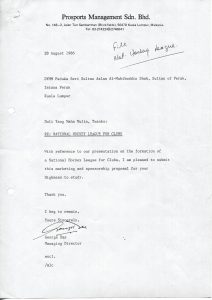
Peter Martinez: The National Hockey League was the brainchild of three people: George Das and this scribe, with former national coach R Yogeswaran giving liberal doses of advice.
George and I had extensively covered the first national junior hockey team as it grew under the stewardship of Yogeswaran with the inaugural junior World Cup in Paris in 1979 as its focus.
Inspired by Malaysia’s outstanding performance in the 1975 World Cup where they finished fourth on home soil, a never before seen generation of superb hockey players emerged from the schools of Perak, Selangor, Negri Sembilan and Malacca.
Even now, nigh on 40 years since I first met that group and 30 years since I left Malaysia, many of the names are still fresh in my mind — such an impression this group has left on me. Foo KeatSeong, Wallace Tan, Ahmad Fadzil, Mohamed Sayuti, Stephen Van Huizen, Colin Sta Maria, M Surenthiran, Razak Leman, Updesh Singh, Kevin Nunis, Derek Fidelis, Chin Boon Gee and Tam Kam Seng.
At the time when George, Yoges and I got together in 1986 to discuss the state of the game, Malaysian hockey had failed to build on the triumphs of 1975 and ‘79 when the juniors also finished fourth.
We thought the game needed a season of tough competition, like the English football leagues, rather than relying on local club competitions and the annual Razak Cup inter-state tournament.
Also, at the time many commercial institutions — banks, United Asian Bank for example, were hiring sportsmen and women to shore up their ambitions in winning their industry’s sports competitions.
We were also aware of the fact that the country had lost talents such as Updesh (to play professionally in France with Racing Paris) and Kam Seng (who never made it to the Paris finals, opting to seek a trade in hair dressing).

cof

We reasoned that if commercial outfits could be pushed into hiring top hockey players, giving them job security and a secure future (as government institutions such as PKNS and Kilat had been doing for many years) then the country would not lose such players.
So at the end of a talk that was comprehensive with ideas flowing, it fell on me to write a proposal to present to then head of the Malaysian Hockey Federation, Raja Azlan Shah, the then Sultan of Perak. But first, George and I spoke to ‘Ungku’ about the idea in broad terms and he gave me the greenlight to write up the proposal.
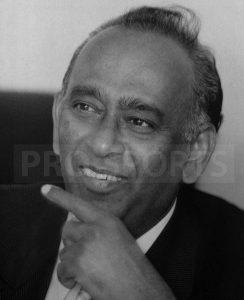
‘Ungku’, though many thought he was aloof and abrupt, truly held the sport close to his heart.


For some reason, he had taken a liking to me and many a time, I would be summoned to his chambers in the High Court at Kuala Lumpur to discuss things hockey. He was then chief justice.
It was not a discussion, though. He would ask me a question and expect an answer. But I also got an insight into his views on the sport, and the players.
So I can say that I knew him well at a certain level and could talk to him. If I put things in perspective thoroughly, he would come on side with our idea.
Writing up the proposal was the easy part — took me about a couple of hours banging away on my dad’s old Olympia typewriter.
We then took it to Raja Azlan who was staying at Istana Perak on Bukit Persekutuan. He read through it and said we should take it to senior MHF council members for consideration.
But George and I had already thought that one out. If we took it to the council, the proposal might not see the light of day. It would be buried because the idea did not come from the council, but from two reporters who had on many an occasion been thorns in the side of the MHF.
“We would prefer it if we took the proposal to a full council meeting with you present,” I replied. “We think that with your backing, the council will have no choice but to consider it openly,” I said.

And thus it was. I returned to Istana Perak with George at the next council meeting and with Raja Azlan present, delivered our proposal. We must have been convincing for the proposal was adopted and the National Hockey League was inaugurated in 1987.
I have heard, from a distance, some word that George’s and my involvement in the formation of the national hockey league may have been questioned and in fact downplayed at best. I have a testimonial from Raja Azlan when I migrated to New Zealand in 1988 that credits me with helping establish the NHL.

Get Out of Ipoh!

By
George Das: It was blazing hot. The sun was unkind on this mid-afternoon in November of 1979. I stepped on to the Ipoh Municipal ground, a picturesque ven- ue nestled in the centre of this once-rich tin mining city of Ipoh in Malaysia.

Walking beside me was the late Jamaluddin Yusof, a sports journalist colleague from Bernama, Malaysia’s national news agency.

As we arrive within hailing distance of the hockey pitch, we could see a large crowd of fans, numbering about 5,000. They were  there to watch the Malaysian Under-23 final. The match was between Malaysia’s Junior World Cup side and Perak Under-23. I was uneasy as I felt that many were glaring in our direction while snide remarks were being hurled.  At that moment I wasn’t sure if it was me they were after.

Suddenly, I didn’t know which was worse: the scorching sun or the invective emanating from a partisan crowd.

Sniggering, derisive laughter, and caustic remarks told me something was not right and that I was the brunt of their ire.

Then Jamaluddin pointed to the banners being displayed directly opposite from where we were standing.  There were several held high by the Perak supporters.

All of them had  the same wording: “George Das — get lost from Perak.”

I did not know whether to be proud of the recognition or disturbed by it, but that’s when I knew that I was the butt of their animosity.

All this was due to a story I wrote for the New Straits Times, calling on the Perak players to play hockey instead of trying to “maim” their opponents.

The Perak fans did not like my article one bit. I learnt very much later that this was an organised protest to vent their displeasure on me.

Several years later I had to run for my life. It was a different scene altogether. This happened in Alor Star when nearly the whole Kedah team made a beeline towards me after the match.

On this occasion, I was with M.Bala of  The Star when the players with flaying hockey sticks dashed towards us outside the venue.

The quick thinking Dasheer Noh, an umpire, bundled us into his car before any harm befell us.

All this was part and parcel of our working life. I continued covering hockey at these venues, meeting the same supporters and players, some of whom became friends and they would joke about those incidents with a laugh.

THE DREAMER & HIS WIFE


Beautiful people don’t just happen. The most beautiful people we have known are those who have known defeat, known suffering, known struggle, known loss, and have found their way out of the depths.

This quote by Elisabeth Kübler-Ross, a Swiss-American psychiatrist, very well sums up the life of cycling legend, Shaharuddin Jaafar. He very well embodies that personality which Elisabeth espouses with one additional trait – he was also a dreamer.

For more than half a century his dreams have revolved around cycling. Whether as a cyclist or an official, Shaharuddin has never stopped dreaming of a better future for the sport in Malaysia. You could not have a better friend in Shaharuddin either. His unassuming personality and readiness to make friends with all, is a trait sorely missed these days.

You could actually write reams of stories about  Shaharuddin and his cycling dream. But if there is an untold story about this dreamer, it must embrace Hasmah Ibrahim. Who is she you might ask? Well, Hasmah is his wife of 51 years, the driving force behind his dreams.

A woman with a disarming smile and gracious hospitality that cannot be missed on any visit to the family home in Shah Alam, Hasmah cannot be separated either from Shaharuddin’s successes nor his struggles. She has always been there for him, giving the 1965 SEA Games gold medallist encouragement when he was feeling down or struggling with problems, whether related to cycling or the family.

Income from the catering business she ran, helped fuel Shahruddin’s dreams for cycling as much of the support for his ever present group of young cyclists, came from his own pocket.

I still remember in the 80s, Shaharuddin and Hasmah putting up between 9-11 cyclists in their house. Hasmah cooked their meals and was very much the mother to the riders. I  never heard her grumble about her husband’s ways. She understood him, his passion and dreams so very well.  Shaharuddin was a cycling coach with the Ministry of Youth and Sports at this time and together with their three own children , it must have been a struggle for them to spend out of their own pocket, to ensure the cyclists could focus on the competitions ahead.

Think of all the times that Shaharuddin was away at competitions and she had to manage the home and their three children on her own. It required sacrifices and Hasmah’s own is very telling.

She tagged along with Shaharuddin to the training venue and also competitions. She was and still is his pillar of strength.

If there is a tribute to be given to Shaharuddin, Hasmah deserves her fair share. Sadly, for the past six years, she has been living with cancer. Yet, those stopping by their home will not hear her express regrets over her husband’s dream or what they had sacrificed over the years.

It may be symbolic that I chose Elisabeth Kübler-Ross to frame this story because she is also the author of the ground-breaking book on death and dying- the five stages that terminally ill patients experience.

This story is thus about two beautiful people, two beautiful lives, given over to chasing one dream.

The Man of Sorrows


By
A.Subramaniam

When he passed away in August 2012, accolades were heaped on Punch Gunalan for his accomplishments both on and off the badminton court. The tributes were fitting for a man who truly did much for the cause of Malaysian and international badminton. but the sport had also at times, dealt him a bad hand. The year 1992 should have been another vintage year for Gunalan.
On May 17, that year, Malaysia won the Thomas Cup after a lapse of 25 years. Gunalan was the team manager and if I might say, the architect of Malaysia’s success against the formidable Indonesians. A few days later I met up with him at the Badminton Association of Malaysia (BAM) office at the Cheras badminton stadium. Gunalan was also the BAM secretary and his face was forlorn and had sorrow written all over. An irony, if you ask me, considering the backdrop of ongoing celebrations over the Thomas Cup success.


It pained him to talk of the sadness within. But in the conversation that followed, Gunalan opened up that certain individuals were seeking to triviliase his contribution to the team’s success. The remarks had cut deep and he was struggling to finds answers as to the rationale for their action.

It was not easy for Punch as we all knew him. He had given his best to assisting the team get their strategy right for the final. He was proud of the victory. Who can forget Gunalan racing into the court at Stadium Negara to hug Cheah Soon Kit and Soo Beng Kiang as the doubles pair gave Malaysia victory in the deciding match? Therein, lay the problem. Punch being in the limelight was not to everybody’s delight.
“I was just as happy as everyone else,” he reflected on that moment. Then, at the end of our conversation, he said something quite profound and which I remember till this day. He got up and said in a rather satisfied tone, “It’s all right. I am the one sleeping with the Thomas Cup in my room!”.
No one or nothing was going to take Gunalan’s own defining moment away from him. For sure, he deserved it.

This, however, was not the end of the troubled times for Gunalan. Just two months later, at the Barcelona Olympics he would be caught in the crosshairs of another difficult moment. In an event that did not quite make the headlines then, he found himself in a fierce argument with his President, Tan Sri Elyas Omar.
I remember watching the scene unfold as Elyas walked over to Gunalan in the corridor of the Pavello de la Mar Bella Stadium – venue of the badminton event. He demanded that Malaysia protest the actions of Korean pair Park Joo-Bong and Kim Moon-soo for “wasting time” in the semis of the doubles event against Razif and Jalani Sidek. Presumably their actions contributed to Malaysia being deprived of the chance of doing better than the bronze we eventually ended up with.


The argument was heated and Gunalan tried to reason that it was pointless to make any protest. Elyas was adamant. I can’t recall if Malaysia did lodge a protest but that altercation between two previously “fast friends” was the beginning of a breakdown in their working relationship. Interestingly, Gunalan’s reluctance to lodge a protest was attributed by Elyas and some others to his position then as the International Badminton Federation (now BWF) Deputy President. Gunalan was deeply hurt by the allegation and it snowballed into other incidents which deepened his moments of sorrow.
One other such moment came when Gunalan was being harassed by certain parties with allegations that bordered on slander. It led to a television station crew harassing his family as well by turning up at his home unannounced with a camera and taking his wife by surprise.


He shared with me that he was greatly saddened by this and in the midst of this scenario, called up the then BAM Patron, Tun Dr Siti Hasmah for help. But intentionally or otherwise, she did not take his calls. It was a far cry from “once upon a time” when he had easy access to her for assistance on a range of issues . I believe, this incident was the last straw for him and he called it a day in the BAM soon after.
For Gunalan, badminton was his joy and ironically, sorrow too, as subsequent events, including his ouster from the BWF, would show.

Gentleman Paul


By
Hishamuddin Aun: You must be new, eh? Those were the words I remember vividly how Paul Mony Samuel (later a Datuk Seri) greeted me when I met up with him in his office as the Assistant General Secretary of the Football Association of Malaysia (FAM).

It was my first four-eyed meeting with the man – long after everyone had left the building — after one monthly FAM Council meeting in 1982 that normally convened on a Sunday.

Yes, I must admit I was still wet behind the ears then, and going to meet him alone with no one for company required more than just a bit of courage. The prospect of facing this colossal personality, was intimidating, to say the least.

And the fact I had just been assigned the beat of a football writer by my employer, Berita Harian, was not made any easier by the popular belief then that Paul was not friendly with the vernacular press.

It was small wonder why my colleagues then preferred to cover team trainings and football matches rather than making   frequent visits to Wisma FAM. In fact, to some, he was even branded a racist. If anything, some quarters would claim Paul would only talk to the English press unless it was a pre-arranged press conference where he had to address all and sundry.

How these people would portray him as someone who looked down on the Malay press – albeit it was us who should take the blame for our lack of confidence and eloquence and being scared of the man himself.

Alone just among us, football reporters from the Malay dailies at that time, I remember the constant shoving for me to take the lead whenever we chanced upon Paul close to the field next to Wisma FAM where the national team would have their trainings.

Honestly, we did not know how to start a conversation with him and we feared saying the wrong things or asking the wrong questions that might lead to a rebuke from him.

In retrospect, I find it rather weird and peculiar as Paul, a former school teacher in Kuala Ketil, Kedah and later a lecturer in a teachers training college, was equally conversant in English and Bahasa. Not only that, he was friendly and endearing too.

Ask him a question in Bahasa and he would enlighten you in text-book Malay that would be more than good enough for you to quote him verbatim.

However, he was said to be a man who gives very little information and was famous for the “don’t quote me” and “this is strictly off the record” kind of instructions.

Initially, I fell for that too – always hiding behind my seniors from the New Straits Times, The Star and The Malay Mail in wanting to avoid eye contact with the man and also not having to ask any questions but conveniently copied the answers and explanations he gave them.

But that brief meeting in his office in 1982 – meant to introduce myself as I did not have such an opportunity earlier — changed my perception towards him completely. And I must have summoned enough courage in between stuttering to share with him how he was often described as unfriendly to the vernacular press – by reporters from the Malay press mostly –and instead favoured a select few from the English press.

Upon being told that, Paul was more amused than offended.

“Siapa yang cakap ini?,” he boomed back. That was Paul to the core, sensitive to remarks like that, especially when they weren’t true. It would affect him terribly.

“I’m always trying to be fair to everyone so long as they come up to me in wanting to confirm something or to ask for an explanation on an issue. But the problem is I don’t see too many reporters from the vernacular  press over anything. “Are they afraid of me or what?,” he chuckled. “So, please tell your friends they shouldn’t think that I am like that at all. And they are most welcome to see me on any issues,” he quipped. “Afraid” may not be the right word, it was more like having “too much respect”.  We were simply overawed by this man’s knowledge of the sport. He was always alert, and could handle any question, even the curving balls often sent in his direction, with relative ease.

I also learnt during the months after that that Paul wasn’t someone whom you could go up to and simply ask for ‘a back page lead story’. He will show you the door, and tell you not to waste his time.

With him, you have to come prepared if you are trying to fish for some quotes pertaining to an issue or feel like engaging him in a discussion on a specific subject matter. For, Paul had so much on his plate, as he micro-managed as well.

Was he a racist? Not Paul, not even by a long shot. He was a professional, who would answer any intelligent question put to him, to the best of his ability.

Everything was at his fingertips. Be it the rules of the game, the FAM constitution, problems the players were going through, dates, events, you name it and he knew them all. Which is probably why, he didn’t suffer fools gladly.

When he talked to you, explain a policy or a decision to the press, I couldn’t help visualizing, that it was as if he was standing in front of his class, talking to his students. For, he was patient in explaining it, making sure you understood the core of the message, so you won’t get it wrong in the papers the next day. He was both  articulate and coherent.

At the workplace, he was a different animal. There you would only see  the stern demeanor, the dogged diligence, and the meticulous manner in which he went about his ‘Call of Duty’, as General Secretary of FAM/AFC, FIFA Instructor, general coordinator of three World Cups, and the many other roles in which he served the beautiful game. But behind that administrator was a man with a heart of gold. He was blessed with a giving heart. Even if it wasn’t within his means, Paul would never turn away anyone who came to him for help.

For, to Paul nothing made him happier than being able to put a smile on those forlorn faces who had sought him out. He could have been a multi-millionaire from the positions of power he occupied, but that wasn’t Paul. He didn’t chase rainbows for the pot of gold.

He just wanted to be relevant, to be able to fix problems, to share his knowledge and vast experience with his charges, and leave a lasting legacy.

And he never did all that for his personal fame and glory. In fact, he was publicity-shy.

Paul would never surpass the president, the council and the exco but would rather let the top brass of the FAM enjoy the glare of the limelight.

Although he would be the one providing the gems that make for a great copy, he would always ask us to quote his boss, the then president of FAM, Sultan Ahmad Shah. Such was his respect for protocol that present day issues like the Players’ Status Committee requiring 100 days just to convene a meeting, would have been unheard of during his time.

In spite of all that, there were a couple of ‘attempted coups’ to oust him from the General Secretary’s post that were mostly racial in nature. But Paul survived each time, with the solid backing of the FAM president though his dedication and hard work would have been his best defence.

During his heyday as a football administrator, Paul to us was perhaps the most intelligent, articulate and knowledgeable football official we had ever met.

And, from that first four-eyed meeting in 1982, I will always remember Paul for being firm but fair and always had a clear understanding that a journalist too had a job to do. It is for that, too, I would forever be in awe of the man whom I have my highest respects for as a football administrator extraordinaire and a friend.

MOST COMMENTED

Get Out of Ipoh!

Shattered Dream

Toddy Goal Does It!

- Advertisement -