Home Blog Page 19

In the beginning

By
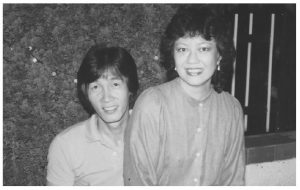
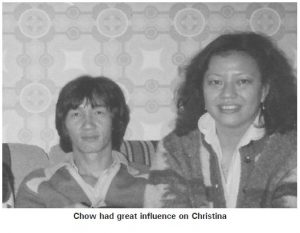
Christina Kwok: I was only 13 years old when we first “met”. Seems a bit young, now when I think back… but it was all very innocent . I remember being in my father’s “temporary office” located in one wing of the Merdeka Stadium during the 1968 Merdeka Football Tournament . He walked in – he saw me, I saw him.
We next laid eyes on each other a few months later – again at Merdeka Stadium – after another football game. He was bounding up the stairs to the F& B on the top level. I was standing by the ticket turnstiles – again, waiting for my father to finish whatever he was doing, and to go home.Halfway up, he yelled to me “I didn’t recognise you!”…to explain – I had undergone a small metamorphosis – changed my spectacle frames, hairstyle, and perhaps grown taller. I was by now 14 going on 18… and since I was rather tall for my age, I guess many people thought I was a lot older than I actually was.
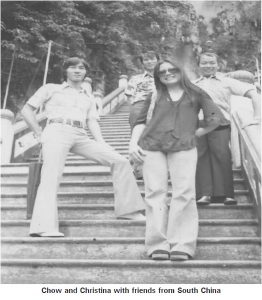
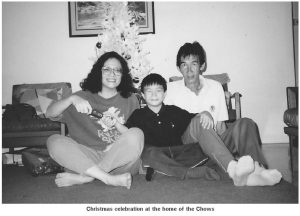
And that was that – my father showed up, ready to go home at last, and off we went.
A few days later, I was at home – upstairs, watching TV –“ Mission Impossible” in black and white, and the phone rang downstairs. It was around 9-something in the evening, and we hardly received any phone calls after 9pm.
My parents were out, brothers in bed, maids in their room. I dragged myself downstairs and picked up the phone and spoke with a rather abrupt “Hello”. At the other end, a rather deep voice, said “Hello, may I speak to Christina please?” “Speaking…who’s that please?” He asked me to guess – and I couldn’t for the life of me guess who !! Well, the rest, as they say, is history.

If you are amazed that over 50 years later, I can still remember this so vividly, it will give you a measure of the impact and influence Chow Chee Keong has had on my life .
There followed years apart – me in the UK completing my education, he in Hong Kong pursuing his football career – he was the envy of many of our friends, “playing” and getting paid for it! We saw each other in a good many summers, when I was back in Malaysia for the holidays and it was off-season for him.
We eventually tied the knot when I was the respectable age of 24, and then it was back to Hong Kong for another few years as a married couple, before settling down back in KL. Adrian came along shortly after, and Chee Keong was

by now focused on embarking on a second career as a professional golfer.
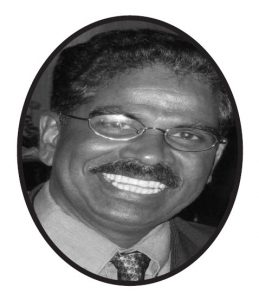
Adrian has only really known his Dad as a golfer. But he has been privy to observing his father’s discipline and tenacity of purpose in “practice practice practice”.
In 50 years, a couple in a relationship can amass a ton of ups and downs – and we were not spared the downs. But what did not kill us made us stronger. One of my close relatives used to say – Chee Keong was the kung fu master, and I was the one who successfully carried the burning Shaolin pot across the bridge…and then came back for more!!
Looking back, I learnt many life lessons from him and from “the other side of the track”. We came from pretty different worlds, but from the beginning, we knew there was this “thing” between us – and whatever this “thing” was, it carried us through till the end.
Beyond soul-mates, beyond the unspoken common values, beyond the excitement and passion, beyond being best friends, the love we shared took us to heights and depths .
We had plenty of good times, fulfilling times and also trying times…but hey, whoever said it was going to be easy with the likes of Chow Chee Keong?!

We Were One As a Team

By
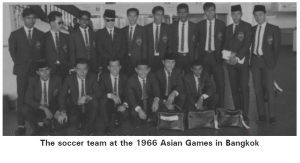
M.Karathu: Tunku Abdul Rahman’s contribution to football in Malaya and Asia, remains legendary. He was the father of football.
He built the Merdeka Stadium in 1956 for our country’s independence. The following year, he launched the Merdeka Tournament, the first international friendly tournament in Asia. Apart from the Asian Games every four years, the Merdeka Tournament, was the biggest football event in Asia and it was played annually.
It attracted top Asian countries like South Korea, Japan, India, Hong Kong, Taiwan, Thailand, South Vietnam, Burma,and Indonesia back in the days. For these countries, it was the only international tournament where they could hone their skills. It was the most talked-about tournament in Asia then.
When you had a Prime Minister who was also the head of football in the country, you know for certain that the sport will thrive, with Government support.
The civil service absorbed footballers into their departments, thus prompting parents to be supportive of their children’s love for the game. Football, in fact sports generally, was an integral part of our lives. It was part of our culture, and it bred and cultivated unity among sportsmen and even women of all races and religion.
There was no segregation of the races. During centralised training, the managers weren’t looking at us by race or religion. They only saw Malaysians before them. Malays, Chinese and Indians were housed together. We ate the same food that was halal. We prayed openly in our own ways. And we felt the spirit of brotherhood.
There wasn’t a need to inculcate us with the 1Malaysia spirit, as we were already practising it spontaneously, and we were growing up. No one had to teach us about unity, we were already united.
I must draw reference to this one incident that happened in 1967. It was in the Asian Cup tournament. We were playing against South Vietnam in Hong Kong. We were leading 2 – 0, and there was 10 minutes remaining in the match. A Vietnamese player kicked our goalkeeper, Lee Soo Phang, and he had to be immediately taken to the hospital.
Vietnam had already changed two players. The referee showed him the yellow card, but he could still continue the next ten minutes. We were furious, and rushed to the Vietnamese player and harassed him so much that he walked out of the field.
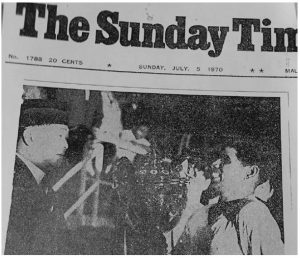
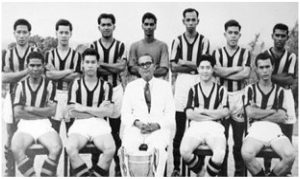
We were one in spirit. There were no Malays, Chinese or Indians, we were Malaysians in mind, heart, and spirit. Immediately after the match, we visited Lee in the hospital, to show our support. It’s hard to see that kind of team spirit in our players these days.
In training we develop our national pride, and commitment to the nation.
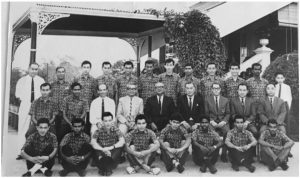
Our home was the dormitory in Merdeka Stadium. Our coach was the late Choo Seng Quee. He was a fierce disciplinarian, and a great nationalist. Before we start our training, we have to sing the national anthem every morning at 5.00am. We sleep and eat together as one family, and representing our country was our priority.

Other than dumb-bells and benches, we didn’t have a gym to do strength training. From Merdeka Stadium, we used to jog to Kuala Lumpur Lake Gardens, which was about 10 kilometres away. At Lake Gardens, we would run up the hill slopes to strengthen and develop our muscles.
We didn’t complain about the pain or the fatigue. We were doing this for national pride, and coach Choo, will not hear any of our complaints anyway.

There was one occasion in training, when we had to do laps around the stadium. It was 5am, and it was still dark. One of the players, who couldn’t handle the strain of training, hid in the dark side of the stadium. But the experienced coach, counted the number of players who ran past his post. and he noticed one was missing, and knew who he was.
During breakfast, he told the player to pack his bags and return home. I still remember what he said, even though it was more than 50 years ago. Choo told him and us generally: “When you cheat in training, you are cheating your country too.”If a coach was to do that today, he would have been sacked, and the culprit will be pardoned. That patriotic spirit of fighting or dying for your country on the playing field, isn’t there anymore. Indiscipline is condoned, and it doesn’t matter to players if they win or lose, as long as they get their fat salaries.
I am just glad, that I came from an era where unity was a given, patriotism was not an option, and football was the pride of our nation.

Harun’s Tragic Fate

By
Terence Netto: In 1973, when I began as a cadet reporter in New Straits Times, I was made quickly aware that Dato’ Harun Idris’s magnetism as a sports leader was a byword among senior sportswriters. He was a charismatic politician whose love of sports resembled Tunku Abdul Rahman’s and he shared the founding prime minister’s confidence that the medium would unite the diverse peoples of the country. Harun had studied at Victoria Institution, renowned spawning grounds of the societally eminent, and after graduating in the law from the Inns of Court in London in the early 1950s, became legal adviser to the Selangor government later that decade. He was president of the Selangor Football Association.
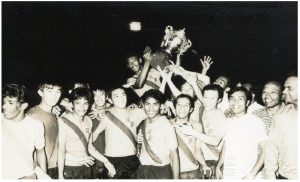
As manager of the highly successful Selangor state team in the national league, Harun rose in the ranks of the Football Association of Malaysia to become vice president by the mid-1960s. Simultaneously, he was manager of the national football team, a tenancy that would be marked by increasing success as Malaysia won the Merdeka Tournament in 1968, after a title-drought of several years, and qualified for the 1972 Munich Olympics, the first time we ever did.

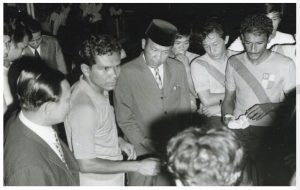
Harun (in songkok and tie) huddles with Selangor legends Ghani, Chandran and teammates

In tandem with his sports-leadership career, Harun’s political ascendancy gathered pace. It accelerated after he became leader of the increasingly powerful youth wing of his party, Umno, which by the early 1970s had become the dominant force on the political scene.
Umno Youth became assertive. The social engineering process afoot in the country gave it newfangled prominence. Under a leader whose public profile was rising on the national sports scene and whose political eminence was embellished by his state’s heft in the national economic scenario, Harun, by the mid-1970s, had become prime ministerial material.
Local sports leaders and organisers drooled in anticipation of a premiership by someone who they were sure that, because of his knowledge of sport and ability to collate advice from experts, would lever the country to prominence as a contender for honours in regional, continental and global arenas.
Football was the country’s most popular sport. The qualification of the national team to the 1972 Munich Olympics was regarded as a sign of its potential for entry into the higher echelons of the international game.
Harun was the manager of the team that qualified for the Munich Olympics in 1972. At that point, he had been manager of the national team for several years, with the qualification to Munich the high point of his tenure. Harun was widely regarded as a players’ manager, in the sense that he knew how his players felt and he made decisions in their and the team’s best interests.
A case in point was the exclusion of striker Syed Ahmad from the team bound for the Munich Olympics. A prolific goalscorer who starred in the qualifying round held in Seoul a year before the Olympics, Syed Ahmad had problems with discipline that were particularly serious during a tour of Europe the squad underwent in the lead-up to the Olympics. Harun, a stickler for discipline, backed coach Jalil Che Din’s decision to drop the recalcitrant striker from the Olympics-bound squad. It seemed that a player’s formidable on-field standing would not be allowed to outweigh what was considered to be serious defects of discipline. Although Harun was mainly a football-focused sports leader, he was keen on other disciplines, especially when these threw up on the national stage formidable exponents from among Selangorians. As chief minister of the state, he was interested in how sports performers born in the state fared in national competitions.
He was known to support these performers when they were in need of aid he could procure for them as the CEO of the state.
1975 was a year of great moment in Malaysian sport. In March, the Malaysian Hockey Federation staged a highly successful World Cup that premiered to rousing crowds and scintillating play. In June, Kuala Lumpur also saw the staging of a heavyweight boxing match between the legendary Muhammad Ali and Britain’s Joe Bugner. For a brief period between March and June, it seemed that Kuala Lumpur was the capital of momentous happenings in world sport.

Another Malaysia Cup victory for Selangor under the leadership of Harun. Here skipper M. Chandran and teammates are seen hoisting the trophy

No doubt, it was a blue riband year. But this auspicious year came with an ominous lining for Harun. He was instrumental in getting the Ali-Bugner match staged in Kuala Lumpur, with matters to do with the organization of the event handled by a newly set-up company called Tinju Dunia. The company would become the subject of police investigations that led to Harun being indicted for corruption in November 1975.
By March the following year, Harun was found guilty and sentenced to prison. The case’s outome presaged the eclipse of a politician-cum-sports leader that many felt was best equipped for leading the country at that stage of its evolution.
In the perspective of the decades gone by, the corruption case against Harun came to be regarded as a political prosecution. His evanescence from the national political and sports scene also came to be viewed as deletrious to our prospects in both arenas for reason of a perceived ability to strenghten the best purposes and suppress the worst instincts of a motley democracy.
By the time of Harun Idris’s death at the age of 78 in September 2003, his eclipse and eventual demise was viewed as tragic, in some sports circles at least. Tragedy is amputation: the strands of memory run to the what-might-have-been had he not encountered the fate he did.

The Legend I Knew

By
Gerald Kwok: When you live with a legend called Chow Chee Keong for so many decades, you lose much of the awe and it has to be deliberately recalled. Worse still when you’re born into my family, surrounded by other “legends”.
As son of the late Datuk Kwok Kin Keng, former Honorary Secretary of the Football Association of Malaysia (FAM) and one of a small group of pioneers who brought Malaysian football and the FAM up from obscurity to probably the most “heavyweight” and strongest established national sports associations in the country by the time of his passing.
Sure there was my Dad but there was also Tunku Abdul Rahman, Malaysia’s first Prime Minister. I do believe that Dad, whom the Tunku affectionately called Ah Keng, always tried to hide me, his source of eternal embarrassment, from view all those evenings I drove him to pre-Council briefings at the Prime Minister’s residence in Jalan Kenny.
But the Tunku always wanted to know – “Who brought you here, Ah Keng? Oh! Your son.” – followed by a cheery wave in my direction.
There was also Uncle Pete – Datuk Peter Velappan – probably the highest-achieving Malaysian ever in terms of status within AFC and more so within FIFA, who recently reminded me that he was already working with Dad .
And, during innumerable tea-time sessions at our old Conlay Road house, all the likes of Uncles Chye Hin, Govinda, Boon Lay, Kee Siong, and the rest, would never tire of swopping stories of glory days past when all my kid brother Dennis wanted to do was wolf down more of those famous Imbi Road currypuffs and doughnuts, without being obvious.
Then along comes this legend Chow Chee Keong. Join the queue, dude.
That he was a legend, there is no doubt. But, for me, it wasn’t about hype and glory. And because of this, my take on Chee Keong will never be anything you would read, hear about or see on TV.
Chee Keong remains one of the strongest characters and forthright personalities I have ever known or will have the privilege to know. For me, it wasn’t about his audacity and absolute, supreme confidence, the kind that allowed him to somehow pluck the ball from the very toes of that even bigger legend – Pele – with a gaping goalmouth on offer, during an exhibition match in Hong Kong.
Instead, allow me to present another take on the audacious Chee Keong. As our Dad headed up Malaysian football in his time, we, his kids, used to pretty much have the run of Stadium Merdeka.
One Merdeka Tournament – I think I was around 11 years old – we were, as usual, hanging around the Secretariat in the Stadium, waiting for Dad. I can’t remember what I was playing –definitely nothing intelligent or productive – but I do remember looking up and seeing this great, green-clad, muddied form checking out my sister Christina.
I instantly flashed red, burning with indignation. What absolute cheek! Who is this muddy buffalo and what makes him think he can just go up and chat up my sister?
Then I look past the mud and I go…. “Whoaaa! That’s Chow Chee Keong!” And promptly had nothing further to say.
From that point, began a story that has been more than 50 years in the telling, a story coloured with its share of Romeo and Juliet style star-crossed lovers stuff.
My Dad was absolutely possessive of his favourite daughter and no way was just any old legend going to come by and sweep her away. No way, no how. So it was tricks aplenty all the way. I can’t give away any trade secrets here but it would include things like us telling Dad, “Sis and us gonna watch a movie today ” which movie we’d never, ever, have to pay for but it would always be me and Denis watching the movie from the front rows and Chee Keong and Christina watching from the back. Like the very last row, right at the very back.
Those years were also years stuffed full of learning, from spending time with and observing first-hand the character traits of one of the strongest men I knew.
Chee Keong was one of the best guys ever to watch football matches with. He could read the game so well he would tell me unerringly this is how the attack will proceed and defenders will have to watch out for this and if they don’t, then this is where the goalkeeper should position himself to secure his goal. It was as if he could see the future and provided live tactical analysis I have never heard, even from the super-pundits on live English Premier League broadcasts.
One game, in particular, he always delighted in watching with me, the same game I always had the deepest dread of watching but he never let me get away. That game was Burma vs South Korea, on the occasions they were pitted together during Merdeka Tournaments. Burma would line up in brown and South Korea in red, which for someone like me with red-green colour blindness, meant they looked like they were wearing identical colours. Chee Keong knew this and he would be beside himself at the look of utter confusion on my face and especially when I’d be shouting, “Aiyoh! The goal’s the other way!”
But one of the games that I did most like to watch was Burma vs Malaysia, with two of Asia’s best goalkeepers on the same pitch: Chee Keong for Malaysia and Maung Tin Aung for Burma. Not many know they were very good friends off the pitch.
Tin Aung called my sister from Burma immediately upon hearing of Chee Keong’s passing – and they had the deepest respect for each other’s prowess. But that never stopped them, even in the tightest of games, from having their private round of one-upmanship.
Chee Keong would pull off a tremendous flying save, then get up and I could almost see him look clear down to the other penalty box as if to say, “Top that, buddy”. Then, on Malaysia’s next attack, Tin Aung would pull off an equally spectacular save, get up and look clear to the other side as if to reply, “Now you top that”.
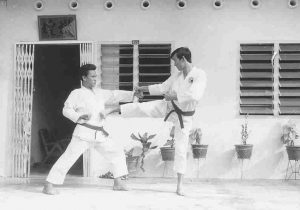
There was much more serious life learning, as well. Chee Keong was ever the sharp dresser, whether to a glamorous celebrity event or to famous satay and ice kacang at the old Campbell Road open-air stalls, a favourite stop after watching matches at Stadium Merdeka. Never fasten the top button of your suit jacket, never push your shirt in completely flat but leave just a neat tuck edge over your belt. I never quite had his knack. He and his buddy Chak Sum used to practise Shaolin Tiger and Crane styles in addition to Karate at the old dojo on one of the back roads off the Loke Yew Road. He laughingly told me it was to outsmart Karate guys with (for whom he had little respect) but this training kept him always alert and watchful – always keep your back protected, always position to see everything in the room in front of you.
Whatever he would share, I eagerly gobbled up and even this abridged version was enough to get me through numerous weekend bar brawls during my student days in Brighton.
Practically everyone who truly knew him would tend to describe him using “humility” or “a very private man” or similar. I think it was more that one had to gain his trust – he never gave his trust away, you had to earn it. Chee Keong never said much when meeting someone for the first time. It wasn’t shyness or disinterest in the person. Rather, as he listened, he was “reading” you. Your eyes, your face, your stance. He was looking at you but he was seeing all of you. Two sentences later, he already knew how much or how little he would trust you.
The one thing he did trust implicitly was the strength of his mind and body, honed by years of rigorous training to do exactly what he wanted it to. Like all true sportsmen, he dedicated himself to the discipline and the craft of his sport. He trained to get the best from himself, whatever the sport he had chosen. I could see him commit to the grind, endless hours repeating every little action again and again till it was perfect.
He always knew talent only takes you so far but it takes hard work and lots of it to rise above the ordinary. For Chee Keong, to be the best he could be wasn’t an ego trip – it was his way to represent the best of the game in himself and his efforts and, in so doing, be absolutely true to his sport.
Honour and respect for his discipline and craft was everything to him. Which was why he was dead set against any form of impropriety like match-fixing. Indeed, he was very proud that he never, ever, took one cent in that way. Anything that compromised his integrity and dishonoured and disrespected his discipline and craft was anathema to him. He took it very seriously.
Honour. Dedication. Discipline. For me, that was what the legendary Chow Chee Keong was all about. The stuff of his legend would never be hype and glory but that of force of will and steely resolve. A strength of character and an uncompromising integrity.
Relentless determination to use every iota of his talent to carve his pathway out of the “wrong side of the tracks” he had been born into. Unwavering devotion to duty and sacrifice to use whatever he earned to fund his younger brother through University and give him the start and the life Bill Chow now has in the USA.
Most of all, his legend was that of an unconquered spirit that rose above anything that life could throw at him …. disappointments, false promises, the fickle and temporary mirage that is fame and superstar status. That was my legend.
Compared to him, I was like some pampered princeling who had lost his way. Yet he loved me and he shared with me his hard side through my growing up and part of that steel helped me conquer my own disappointments, false promises and fickle friends.
Chee Keong has ever been more a big brother to me than brother-in-law. The hole you leave inside me, brother, I cannot fill. Travel well and go in peace.
Legend. Brother. Forever.

Living With The Legend

By
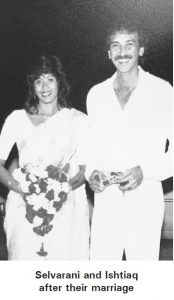
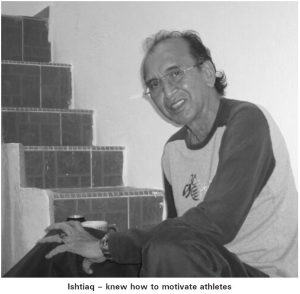
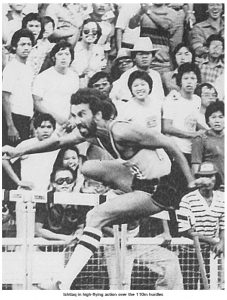
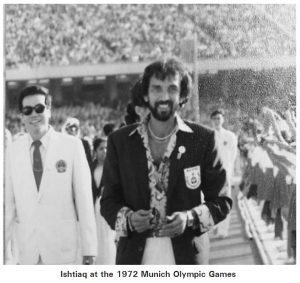
R.Selvarani: He had just returned from Germany after completing his degree and was appointed as a National Coach by the Ministry of Sports.
On my first day at the Kampung Pandan track I was introduced to this tall, dark and handsome guy named Ishtiaq Mobarak. He was my mentor. My mind went blank and I couldn’t focus on what he was saying for the first couple of minutes. I was a young and naive girl eager to become a champion and when he agreed to accept me as his athlete, words could not describe the joy that I felt…Gosh…I just couldn’t wait to return home to share the news with my family, neighbours and friends.
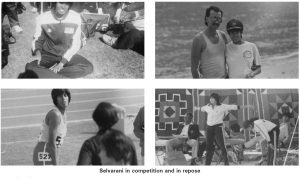
I started off as a high jumper, but within a year he transformed me into a hurdler. Thereafter my journey to becoming a champion started. I was then a little plump and some athletes used to tease me and Ish would always “shut” them up. There were also a couple of coaches who said that he was wasting his time coaching me. Ish took that as a challenge and proved them wrong.


1st Kiss from My Mentor
Ish was offered an awesomely-paid job in Singapore. House, car, utility bills all taken care of by the company, but yet he was not happy. Why? Because coaching was his passion and he was missing all his athletes in KL.
Every weekend he would fly back to coach us, his athletes. One weekend the athletes had organised a party. Ish arrived at the venue, took me to the dance floor and we danced non-stop for two hours. Finally when he sent me back he kissed my hand and said goodnight. I almost fainted (being the naive girl). It was an amazing feeling getting a kiss from your then mentor. I tied a plastic bag over my hand when I took my shower that night. Whole of the following day I was in a daze thinking about the two hours of non-stop dancing, and the kiss on my hand…
Great Coach and Motivator
Ish had his ways of communicating with athletes, coaches, parents etc. He could identify talents, he could handle the most difficult athletes. He does a fantastic job motivating athletes during competitions. Many a time he had motivated stressed out athletes, and second best athletes into winners.
His athletes just loved spending time with him. Many of them loved to visit him on off training days. Some would also stay at our home over the weekends.
There are also athletes who are not coached by him but would love to talk to him before they go for competitions.


A Romantic and Passionate Person
I love the name Ramesh so when Ish and I got married I secretly called him Ramesh at times. On our 1st Valentine’s Day after marriage Ish sent a basket of roses to the house (we were staying with our parents at that point of time) with a beautiful message to me and signed off as ‘LOVE, RAMESH’
Can you imagine how my parents reacted when they saw the bouquet. Both Ish and I worked on that day and when we returned home, saw my dad walking in the living room restlessly. Mum was seated in the living room, looking pale and scared. In their minds both were wondering how Ish was going to react when he reads the message on the basket of flowers. Thank God they were not heart patients then. Upon seeing how my parents were reacting he quickly laughed it out as he didn’t want to put my parents through further stress.
Another Valentines Episode I had left for work (at that point of time we were living on our own). Mid-day he called to say that he was not feeling well and needed to be taken to the hospital. I applied for Emergency Leave and rushed home. As I got into the living room I noticed a large vase of roses (my heart melted) but continued to rush to the bedroom because I kept calling Ish but there was no response. I had a beautiful and amazing surprise as I reached the bedroom door…the whole bedroom walls had stalks of roses pasted on, I am just blessed to have had this romantic man as my husband.
– 1st Wedding Anniversary
Ish sends me a bouquet of flowers to the office and the message read: “I’m blessed and thank you for being my wife – 1 down, 99 years to go”. But as it turned out, God loved him more, and had to take him away after 28 years.
Embarrassing / Funny / Romantic
Once we went out to listen to music at a diners. He stood on his chair and then announced that he loves me.

On another occasion, it was my birthday and he took the girls (both our daughters) and me to an Italian restaurant for dinner. As we were having dinner, we talked about love and family and he was telling our daughters about how much he loved me and how blessed he was to have us in his life.
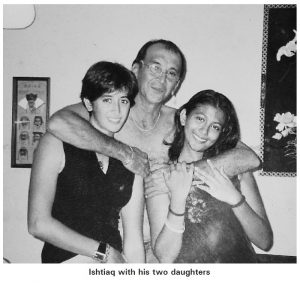
At that point, he stood up with his hands raised and about to get the attention of the people in the restaurant, to announce his love for his family.
However this time around I was quick enough to stop him, while our two girls kept encouraging him to continue with his action. Gosh! I had a hell of a time trying to stop him from doing so.


Grooming
Ish’s teaching and guidance contributed to my success as a Customer Service Manager at my work place. He was one person that I could confide in when I have had a stressful day at work. Particularly so, when I used to have problems with my immediate supervisor. He would listen, then correct me if I was wrong and then showed me a better approach.
Ish was also my personal grooming/dressing adviser. He taught me how to mix and match my clothes, to make up, using the right accessories and even the hair style.
When I first joined him as an athlete and was getting into national ranks, Ish took me to his friend’s salon and got him to restyle my hair which was really short (I had shoulder length hair then). According to him, the shoulder length hair was a hindrance to training. Just imagine how I felt at that point of time (an Indian girl with extremely short hair). I cried and cried and was so furious with him. That night there was a dinner party for the athletes, and everyone who saw me complimented me on my new look. It was only then did I start smiling.
Loves Children
Ish had always spoken about adopting abandoned children. I therefore started contributing to a children’s world organisation. Two weeks before he passed away Ish touched on the same subject matter. As such I had increased my contribution (on his behalf) to the said organisation and also to a local organisation.
Nature Lover
Ish had a way of communicating with animals. One should watch him communicating with the monkeys at our neighborhood.
Our second daughter, Shakira, spends lots of time with her daddy watching National Geographic, Animal Planet etc. Both of them were always exchanging notes on this subject.
Today Shakira has made her name as one of the outstanding naturalists in Langkawi. Credit also goes to her uncle, Irshad Mobarak (Ishtiaq’s brother) who has guided her in this field.
Hobbies
He loved Bikes & Cars – spent loads of time at bike shops/workshops
Loved gardening Likes & Dislikes He ate when he was hungry but every night for supper he had a glass of milk with something sweet i.e. peanut biscuits (Kacang tumbuk) / Indian milk candies.
He loved fruits and his favourite were mangoes.
He didn’t like shopping, be it market, grocer, departmental stores. When we got married his mum advised me that I would have to shop for his clothes too.
He loved simple food, wore simple clothes except when he had to attend a function.
He was not a party going man. In general he was a simple man who lived a simple life.
His threshold for pain was just amazing. He hated going to visit the doctor. If he fell sick as in flu, fever he would not take any medication, instead would drink a lot of water and ate fruits and rest.
He was a simple, humble and passionate person. THANK YOU ‘YANG’ for choosing me as your life partner.


I loved you as my mentor, I loved you as my coach, I loved you as my boyfriend and most of all I loved you as my husband, and will continue loving you till we meet again…
Girls and I still miss you dearly and it still hurts a lot not having you around, but we know that you are a star up above watching over us.

Oh! What a Letdown!

By
S.Sabapathy: Running was my true passion. The joy of training and learning new methods to push your body to new heights was always a priority.

And from a teenager I loved running and winning titles for myself and bringing glory to my country.

But sometimes your country and athletics officials don’t appreciate your commitment, the efforts, and sacrifices you make for the nation.

One disappointing incident took place after the September 1973 SEAP Games in Singapore.

Just before the start of this SEAP Games, the late Tan Sri Ghazali Shafee, president of the Malaysian Amateur Athletic Union (MAAU) back then, promised us that all gold medal winners will compete in November’s inaugural Asian Track & Field championships in Manila.

This was a great incentive to most of us to excel. I won a gold in the 4 x 400m relay, a silver in the 200m, and a bronze in the 4 x 100m relay.

Being a gold medal winner in the relay, I was called up with about 20 others for a one month centralised training stint in Kuala Lumpur.

However, just two days before our departure to Manila, our dream to participate in the Asian meet was shattered when we were told to break camp and return home.

Anthony Rogers, the then MAAU secretary told us that he was notified by a higher authority that this athletics team to Manila resembled more like a “team from Madras.”
Apart from me, I still remember the others…M. Dattaya, Karu Selvaratnam, B.S. Payadesa, Asir Victor, M. Subramaniam, Yamunah Nair, Kumarasen and Ramasamy.
Some were angry, but all of us were totally dejected and offended by the “racial labelling.” We felt let down and rejected by our own country.

One is Not Enough!

By
J.B.Khoo: After the first break of the 5-man team event, we were leading the host nation Thailand by 144 pins in the 1978 Asian Games bowling event.
We had a break in between the game and we were preparing to leave for  our hotel. However P.S. Nathan (MTBC president) told us that in no uncertain terms whatever we did, we were not allowed to have a change of outfits (not even our underwears).
As it was pointless travelling all the way to our hotel, I requested that we have a bath at a nearby massage parlour and MTBC pays for the bath.
We returned to the bowling venue and continued our game in the same sweaty outfits. In the ensuing marathon session, we went on to capture Malaysia’s first gold medal in the Asian Games. The only other gold was won by Saik Oik Cum in the 400m athletics..
For our sterling performance. the late Dato Mohamed Rahmat, the chef-de-mission, promised us a bottle of champagne.
I told him that one bottle he was offfering us was just good enough only for me. On reaching our hotel rooms, there were three bottles waiting for us to celebrate with.
(The 5-man team: Allan Hooi, J.B. Koo, Edward Lim, Holloway Cheah, P.S.Nathan & Lee Kok Hong). feared for our lives. The whole night, we couldn’t sleep as we were afraid that the crowd would have knocked down our doors and taken our lives. At day break, we were informed that we were going to be rushed back to Kuala Lumpur and that the tournament would be temporarily suspended.
The ride to the airport wasn’t without any suspense. Not only were we escorted by the police but imagine this…we had tanks as part of the convoy going to the airport. Until we were safely on Malaysian soil, we didn’t feel safe. We were even suspicious of the plane that was bringing us back, a Garuda which flew us to Singapore and from there we took a connecting flight to Subang Airport in Kuala Lumpur.
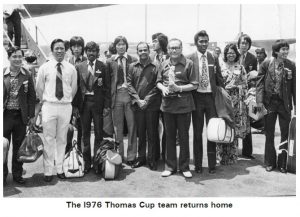
Touching down at Subang Airport, only then could we breathe easy. We were greeted with open arms by not only our loved ones but all of Malaysia. IBF decided later on that the tie would continue in New Zealand, on a neutral venue. Indonesia didn’t agree to the decision and it was then that the Thomas Cup was awarded to us.
This whole incident to me was like going to war for my country. The only difference was that instead of guns and bullets, we were only armed with badminton racquets and shuttlecocks! Everything else was so war-like…the rowdy crowd, the soldiers, the darkness, and the tanks.

(I dedicate this story to the late Norman Siebel, Sports Editor of The Straits Times, who was a great influence on me.)

Long & Lonely Track

By
Karu Selvaratnam: My early years (1960 – 1965) training as a national athlete, was a long and lonely journey.

I had joined the Royal Malaysian Navy (RMN) and was based in Woodlands, Singapore. There was a playing field, (under the Navy’s charge) outside the Base, which required a 500m jog from the Barracks.
Four to five times a week in the evenings, I was there virtually alone, carrying the hurdles, five to seven at a time to lay them along the track. The hurdles back then, were made of solid wood and steel frames. I tell you they were heavy, and painful when you knocked them.
Apart from carrying those heavy wooden hurdles with steel frames, I trained on my own, without a coach to guide me. But the task wasn’t over when I ended my training session. I had to carry them back into the storeroom, lock them up, and return the keys as I was accountable for the equipment.
I was an Engineering apprentice, attached to Her Majesty’s (HM) Dockyard in Sembawang, Singapore. It was a five-year training programme, with no salary, except for an allowance of $90 a month. I didn’t have the luxury of buying a starting block, so I had to make one.
To make myself more competitive, I would travel to Farrer Park by bus once a month on a Friday, and train with the likes of Jega (M. Jegathesan), and the other Singapore athletes over the weekend.
At Farrer Park, I trained on Friday evenings, Saturday and Sunday mornings. On Sunday evening I would take the 4pm bus back to the Naval Base.
Each weekend session to Farrer Park would cost me something in the region of about $25, if I stayed with a friend. If not, it could cost me an additional $5 per night at a budget hotel.

As I was also a National cricketer, there were some weekends, I skipped athletics training and played cricket in the Singapore league for Ceylon Sports Club (CSC) from 1961 to 1965. I also played cricket for Malaya and Malaysia from 1960 to 1965.
Each time I travelled to Kuala Lumpur, or Penang for a National meet, I would take the 10pm train that leaves Johor Baru and arrives in KL at 6.30 the following morning.
During the night journey I would sleep above the 3rd class seats where the luggage was kept. The next afternoon I was scheduled to run in the heats and, on Sunday in the finals. That same Sunday night I would take the night train back to JB, and catch the early morning bus to the Naval Base in Woodlands to report for duty.
If the meet was in Penang, I would leave JB a night earlier, arrive in KL at 6.30am the following morning, and take the 1.30pm train to Butterworth. These travels were tiring because soon after arriving at my destination, without much rest, I would be required to run the heats, semifinals and the finals of the 400m hurdles, the 400m flat and the 4x400m relay, all over in two days. Depending on entries, I could be running five to six 400m races in a weekend. This was quite a normal practice for all state, national meet and government services meets. In 1965 at the MAAU meet in Singapore, where I won 3 gold medals (400m hurdles, 400m flat and 4x400m relay), I ran a total of seven 400m  races, which included the heats, semifinals and the finals. On the second day, I ran four, 400m races, in one of which I set the national record of 52.7 sec in the 400m hurdles for the third time in my career.
In December 1965, I left for England, to begin my cadetship at the Britannia Royal Naval College (BRNC) in Dartmouth. And with that my career in athletics ended, or so I thought then.
But I made a comeback eight years later in the 1973 SEAP Games in Singapore, and had the distinct honour of being the Malaysian contingent’s captain.
I also came back to find a place in the National cricket team from 1978 to 1982, after which I retired. I captained the National team in 1980 against Hong Kong in the Inter Port Series.

Knockout Punch!

By
Tony Francis: Amidst the fog in my memory bank, one experience with Punch Gunalan stands out like a beacon because as someone said, the advantage of a bad memory is that one enjoys several times the same good things for the first time.
It was 1976. Gunalan had made a comeback but as a coach following the end of Malaysia’s golden era in badminton with the retirement three years earlier of Tan Aik Huang, Gunalan himself, Ng Boon Bee and Tan Aik Mong after the Bangkok debacle where Malaysia were embarrassed by Thailand in the Asian zone final after leading 3-1 overnight.
Now, it was a new game with a new generation of players. And Gunalan was on a roll. Early in the year he had taken a team comprising players barely out of their school shorts to a stunning win over Prakash Padukone’s India, coming from 4-1 down to triumph 5-4 in the Thomas Cup zone final in Lucknow.
And as many would recall, Gunalan was so ecstatic and choked with emotion during the post-match interview on radio that he kept saying “Fantabulous, fantabulous” so many times that sportswriters were left scrambling to see if there was such a word in the dictionary.
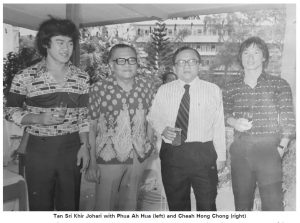
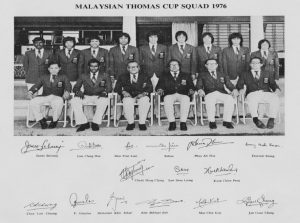
It was Gunalan’s way of describing a FANTAstic and faBULOUS comeback win. It was sheer grit and determination that won Saw Swee Leong, Phua Ah Hua, James Selvaraj, Moo Foot Lian, Dominic Soong and Cheah Hong Chong the tie. But would that be enough for the May-June Finals in Bangkok where the mighty Danes lie in wait in the semifinals? Even the most optimistic of pundits gave the ‘Punch Babes’ no chance against the likes of Sven Pri, an All-England champion, Fleming Delfs, Elo Hansen and Steen Skovgaard.
Like my editor-in-chief, the late Tan Sri Lee Siew Yee. He sent word that I was to take the first flight home after the match against the Danes. “Cut expenses. Save money. No way Malaysia are going to make it. We’ll get the wires (news agencies) to cover the final,” he said.
That had put me in a bind. I was scheduled to fly to Tehran from Bangkok the day after the final as a guest of the Iran FA for the Asian Cup soccer finals where coach M. Kuppan and Mokhtar Dahari and company were up against the best in the continent.
How do I explain to the good Tan Sri about the complications of cancellation and rebooking of flights? It was too late in the day. While Siew Yee was a scrooge when it came to company expenses, he was also passionate about badminton. We respected him for that. After all, he had sailed with Wong Peng Soon and the rest of the Malayan team to cover the first Thomas Cup finals in Preston, England, in 1949. So he knew what was in store for the ‘Punch Babes’. No chance. Or so he thought.
But like the rest, he didn’t reckon on a shrewd Gunalan exploiting the underdogs’ tag to the hilt. “I keep telling the players to believe and achieve,” Gunalan said during one breakfast session with the only two print Malaysian journalists who had made the trip – George Das of The Star and me representing the NST — in the hotel coffeehouse on the day of the match.
He was crafty too. He said he had taught them some tricks of the trade like squeezing the shuttle at crucial moments during service to catch the opponent offguard with the faster shuttle speed.
When I told Gunalan about my predicament if they lose, he laughed. “You must pray harder. Have faith. For us, winning is not impossible,” he said, pointing out that the Danes’ overconfidence and the enervating humidity in Bangkok could work in Malaysia’s favour and cause a Danish meltdown. “We just have to wear them out. We can do it,” he said.
And they did, winning 5-4 over the two nights, with Swee Leong scoring an unexpected point against Delfs and Dominic Soong and Cheah Hong Chong toppling the mighty Pri and Skovgaard for the winning point on the second night. And how Malaysia celebrated.
The win gave me a reprieve. I stayed on for the Final and knew I would be on the plane to Tehran from Bangkok. But I could imagine the look of disbelief on Siew Yee’s face back in Kuala Lumpur though I was sure he was among those who celebrated when Malaysia scored the winning point. It didn’t matter that we lost to the udy Hartono-powered Indonesians in the Final. ‘Punch Babes’ had achieved the impossible.
Gunalan became a celebrity that night and in the days that followed, soaking up the adulation and attention from the foreign media, particularly the Danish journalists. He was inundated with requests for interviews. And the questions were always the same: “How did you manage it? What was the secret? What did you do? “On all occasions, they got the same answer: “I have a bunch of fighters who had nothing to lose and everything to gain.”
In Denmark, they dubbed him the ‘Miracle Man’. In Bangkok, we called him the ‘Joker’ not only because he could make you laugh until your face hurts but because he could also be as mischievous as the next guy.
When George and I caught up with him in his hotel room, we talked and laughed about how people who had nothing to do with the team had hitched onto the bandwagon. Insignificant and unqualified officials were giving interviews on Malaysia’s resounding win as if they had made it happen.
So we decided to get a firsthand experience. It was decided that I should call a senior BAM administrative official and see his response. On the pretext of being a journalist from India who was calling from New Delhi, I managed only two questions but the ‘interview’ lasted a good hour as the official boasted about how he

was instrumental in selecting this young breed of fighters and motivated them and he was sure they would win the Thomas Cup and would be world beaters for years to come. When it was done, Gunalan, in his sarong, was rolling on the bed with tears from the uncontrollable laughter.
Thanks for the memories, Punch. As you would have said, “They were fantabulous.”

“To live in hearts we leave behind is not to die.” – Thomas Campbell, Scottish poet (1777-1844)

Punch – My Love, My Hero

By
Vijeya Gunalan: It all started in early 1970. The badminton team doctor, Dr Ganeson and physical trainer, Mr Nadaraja tried to convince Punch to meet the only daughter of one, K.K Pillai, a good friend of theirs and an avid sportsman and sports fan in his own right.
However, the suave Punch refused, saying that he was not ready to meet anyone at the time, and wanted to concentrate on his badminton training and the 1970 Thomas Cup Finals. However, as fate would have it, I went to the Selangor Badminton Association Hall on 7th April 1970, with my little brother and cousins to get the players’ autographs. They were big fans of Punch and the team.
He immediately took a liking to me, and on the pretext of getting us tickets for the Thomas Cup Finals, he managed to get my phone number. He later confessed that he knew the moment he saw me, that I was the person he would share his life with… and he did.
On the very next day, Yew Cheng Hoe, another member of the Thomas Cup squad called me and said that Punch would like to go out with me.  I was shocked and asked my dad’s permission. My dad immediately gave me the green light. He felt that I would be in safe hands with Punch, and as such he was more than happy with the situation.
At 3pm, a big car with some of the squad members arrived at my porch. They picked me up and dropped us both at the Odeon Cinema in Kuala Lumpur. We went to see Romeo and Juliet. Unlike the movie, our story had a far happier continuation that lasted 42 years.
We became much closer after that. On Sundays, I used to visit him at the chalet where the team were housed. I used to take tea and food for the team as well. We used to go for movies and to restaurants. The two places we frequented were Paris Corner in Bukit Bintang and Madras Restaurant in Jalan Ipoh. Paris corner is no more, but the Madras restaurant is still going strong in the heart of Kuala Lumpur.
My dad decided that we should get engaged soon, as people noticed this Indian girl going out with a famous sportsman. On 5th Sept 1970, we were engaged and on 12th June 1971 we got married. It was a grand affair at the Kalamandabam hall in Scott Road, Kuala Lumpur.
I still remember when we came down for the reception after the ceremony, Punch was swarmed with young fans asking for his autograph. Such was his appeal at the time. The next day, we had a dinner reception hosted by Punch at the Dewan Bahasa dan Pustaka, where the Yang di-Pertuan Besar Negeri Sembilan and his consort were the guests of honour.
Punch was born in Selangor, but grew up and lived with his mother and three sisters, in Seremban. Punch was not a rich man, as at the time, badminton players played more for the glory of the country than for money. Tournaments won were many but the reward was the honour brought to the country and not monetary. He was kindly loaned money by the Badminton Association of Malaysia, to host the reception. The money was returned to them with thanks.
Our marriage was full of love and happiness. The first year, he travelled a lot as a player. I never complained because that was his passion and he was conquering world badminton as a player. In late 1971, Punch was invited to play an exhibition match in Calgary, Canada. He decided to take me along and for the first time, I got to travel overseas in an airplane. We got the opportunity to stop at Hong Kong, Japan and Hawaii. On the return flight we stopped in California and I got to go to Disneyland. It all seemed like a dream to me at the time. I remember clearly in Hawaii, I decided to wake up early and make eggs for him. Unfortunately it was too salty. But Punch being himself, ate it just to pacify me. For many years after, he always used to tease me about the eggs fiasco in Hawaii. We were generally a very happy and loving couple.
Five years into our marriage, in 1976, our son Roshan was born. It was the happiest day of our lives. Punch, though busy, always made sure he spent as much time as possible with his son. He always considered his son his proudest achievement.
Fast forward to 2001, Punch was elated as his son graduated as a doctor. It was one of his happiest moments. That was only topped in 2007, when our darling grandson, Neraaj Madhav Roshan was born. Punch was a dotting grandfather. He would love to spend time with the grandson, but fate dealt a cruel twist to all of us. For, Punch passed on, just shy of Neraaj’s 5th birthday.
Punch was multi-talented. He could handle any job even when under pressure. He was also very forward thinking and would be two steps ahead in most of his plans and projects. He was also talented in other sports. He held the record for pole vaulting in his school, King George V (KGV), Seremban for many years. His forte was however badminton. From a young age, his dad used to train him and he would beat children who were more senior to him.
Punch was also a very good student. He was the top student in his school, KGV, and was the school captain in his final year. He obtained a scholarship from Tenaga Nasional to pursue mechanical engineering in Brighton, England. He returned to Malaysia after completing his studies and worked with Tenaga Nasional (formerly NEB) for five years. After that, he moved on to work at Dunlop. It was at this time that his love for badminton shone through, and he became more involved in the sport he loved. He began to involve himself more in the sport, in a coaching and administration capacity.
Punch received many awards locally, titles, and Sportsman of the Year awards. He received a Datukship from the King in 1992 after Malaysia’s Thomas Cup victory that year. He was the coach and manager for that legendary team on 1992. However, not many know that he was also given a Professorship by the Sports Institute of Sofia in Bulgaria. He received the award from the President of Bulgaria at the time, for his contribution to developing badminton in Bulgaria and other Eastern European countries.
Until today, Punch is probably the only person who has excelled in the sport of badminton as a player, as a coach and manager and as an administrator. A ferocious attacking player who smashed like ‘punches’. He used the same vigour to train ‘his boys’, the Thomas Cup squad from 1988 to 1992. This culminated in Malaysia winning the Thomas Cup in 1992, the last time the nation had done so. He used the same guile he had on court, as an administrator.
A role he pursued to the highest level. Among his unknown successes of his time in the Badminton World Federation (BWF) was to bring the head office from England to Malaysia. Punch also was instrumental in changing the scoring system to the current 21- point system used internationally. His aim was to one day make badminton the number one racquet sport in the world, a dream which was not realised in his lifetime unfortunately. As much as he has done for the sport at every level, it is sad that the current generation do not know the legend of Punch Gunalan.
Anyone who knew Punch personally, would know him as a jovial, lovable character. Easy to get along with. Caring and accommodating to anyone he met. He cared a lot for his family and his friends.  Despite being busy, he would spend as much time as possible with me and his son. He would always put his family first.
He was a happy-go-lucky type of person. He had an infectious and characteristic laugh that was instantly recognizable to those who knew him. He would enjoy every celebration and party with his family and loved ones. Always being the loudest among the crowd. He was always happiest when he was surrounded by those he loved. As a husband he was kind and loving with a slight temper. However, his anger never lasted more than 15 minutes and we would be best of friends again soon after.
Despite travelling far and wide, every birthday of mine, he would send me a bouquet of flowers. That was the loving husband that he was, even until his final days. I miss that the most, every birthday since his passing.
Punch suffered a heart attack in 1995. However, he recovered and was well. Until he underwent surgery to his spine in 2006, and subsequently had a coronary artery bypass in 2007. In late 2008, he retired from his post as the Vice-President of the Badminton World Federation. After which, health issues started to take its toll on him. In late 2010 and early 2011, he was diagnosed with Parkinson’s disease. His condition slowed him down tremendously. The once active and eloquent Punch was becoming shakier physically and his speech was slurring and slow.
The worst was however yet to come. On 26th Feb 2012 he complained of back and stomach pains. Thinking nothing of it, he did not seek any treatment or consult any doctors initially.
As the pain persisted, we visited a doctor in Jalan Ipoh, only to find out that my beloved Punch had a tumour.
He was diagnosed with Cholangiocarcinoma (a rare cancer of the gallbladder) which had spread to the liver. The prognosis was bleak.
To me, at the time, I felt my whole world crumble into a heap. Punch was calmer than I was. He was consoling me as I was crying the whole journey back home.
We spoke to our son, who had a private talk with his father at the time. Something I was unaware of, until his passing.
On the 3rd of March 2012, we saw a hepatobiliary surgeon. He was not very optimistic of Punch’s chances. He had only given him six months.
I was not told of this duration, but my son, who is a doctor was well aware of the situation. We took him to several hospitals and consulted several doctors and specialists. Hoping against hope that something could be done for him. Over the next few months, he got weaker. He was tired, spoke very little and never really complained despite being in a lot of pain.
Punch took everything in his stride. Knowing he did not have much time left, all he wanted was what had kept him happy all these years… to be surrounded by those he loved. His three sisters who live in Melbourne came down and stayed with him over his last few months.
In June 2012, his condition worsened. He was weaker and jaundiced. His appetite was poor and he was losing weight. He also had difficulties moving his limbs as he was very weak. On 4th Aug 2012, he was admitted to Subang Jaya Medical Centre. The place brings such mixed memories for me. In 2007, the most joyous with the birth of our beloved grandson, and in 2012, the loss of my beloved Punch.
During his admission, he had a steady stream of visitors. From family, to his former school friends, friends from various stages of his career. He had visitors from overseas, he even had total strangers visit him, as they knew that Punch Gunalan was admitted. Several former and current badminton players whom he had previously trained visited him almost daily. We and our family were very touched by these players who spent time daily just to see him and keep him company, despite him being at his weakest. On 12th Aug, he tried to see the men’s singles finals of the London Olympics, where Lee Chong Wei played Lin Dan. He predicted a Lee Chong Wei victory, which wasn’t to be.
Punch loved to be surrounded by those close to him. He lived his life like that. And at his final passing, he was surrounded by those who loved him the most. I held his hand through the night, as my son sat on the other side of the bed from him. Knowing that he was fading away. Away from me after 42 years of love and memories.
At the dawn of 15th Aug 2012, at 6.00am, my Punch finally left me. He took his last breath holding my hand, and my son’s in his other hand. I felt like everything from me had gone. I felt a void that will never be filled again. Can I ever forget all this? Not until my last breath.
On that fateful day, I lost my pillar of strength, my soul-mate, my best friend….my legend, my hero. Five years down the line, I still miss everything about him. But I still cherish every moment I shared with him. For 42 years…. I was truly blessed.

MOST COMMENTED

- Advertisement -