Home Blog Page 20

I Ran Away From Training

By
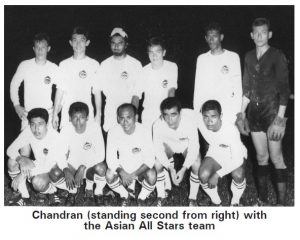
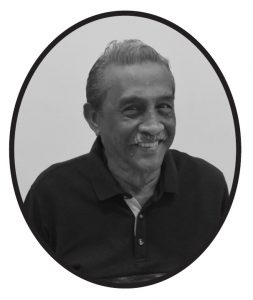
M.Chandran: I ran away from my first national training camp at Merdeka Stadium in August 1961!
I could not imagine this episode would be the start of a 12-year association with the country’s youth and national teams.
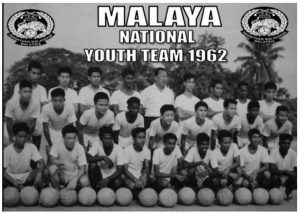
Looking back at that first call-up for the Asian Youth Under-20 football competition in Bangkok which was held the following year, I was just 18 years and very wet behind my ears. I was still in school when I was called up for training with 29 other players.
I was really excited but this excitement didn’t last long. In the first six days of my training, it vanished and I was devastated.
I never imagined that training as a football player could be so tough. I just couldn’t endure the sessions. It was torture. Physically and mentally, I just wasn’t able to take it.
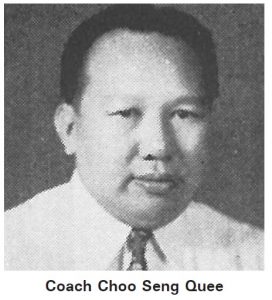
Uncle Choo Seng Quee was a no-nonsense coach, a real taskmaster. A big fella, standing over six feet, he put us through a punishing physical routine, something I had never experienced before. All I knew was how to play with a ball.
The weight training from 6.30am to 7.30am in the Merdeka Stadium carpark was something I wasn’t able to handle.
And immediately after breakfast I had to run off to school. On returning to camp in the afternoon, we had to undergo another one-hour fitness training. Again it was something I dreaded doing.
The only session I liked was when Uncle Choo put us through tactical training for 90 minutes on the Merdeka Stadium pitch in the evening. I enjoyed touching the ball more than all the physical endurance training.
On Monday, a week after being in camp and immediately after the morning session, without anyone noticing it, I packed my boots with my books and left for school – never to return to training camp. No one came looking for me.
I thought that this was the end of the road but in April 1962, I was recalled for the second phase of training. On reporting to Merdeka Stadium, Uncle Choo straightaway recognised me and remarked, “You ran away the last time. From now on you’ll sleep on the bunk next to me.”

From then on he kept a watchful eye on me. He was an excellent coach and was nice to all of us. However, when it came to training he was a disciplinarian.
He was a stickler, too, for punctuality at training sessions and his physical fitness regimen turned out well for us in competition. From him I learned that if you are very fit you are less likely to get injured.
I was again called up for the third phase and to my surprise, I was selected to represent Malaya in Bangkok in the Asian Youth tournament. In fact I played as a centre half in all the matches where we finished fourth overall.
My love affair with the national team started from here and I owe it to Uncle Choo. He was the one who put me on this path and I have great admiration for this man.
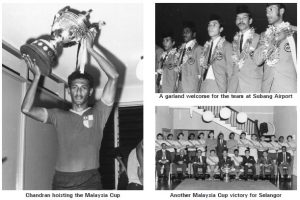
Footnote: Chandran captained the Malaysian team to the 1972 Munich Olympics, the one that Malaysia participated in. He was skipper of the 1974 Teheran Asian Games team which won the bronze medal for the first and only time in the Asiad series.

My Football Dream

By
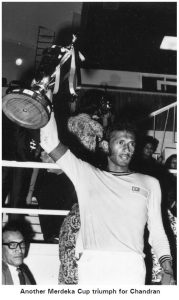
M.Chandran: In my 13 – year international career, playing in the 1972 Olympic Games was without doubt, my greatest football dream come true. What this 1972 Malaysian team achieved is not only a first in the annals of Malaysian football, but it was something that has never been repeated.
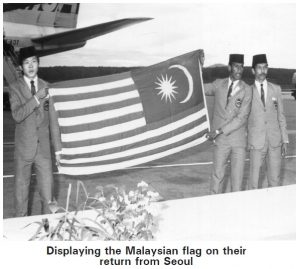
And this team did it in style. We qualified for the Games with an unbelievable victory over South Korea. It was not easy to beat the Koreans on their home ground in Seoul but we surprised them 1-0.
It was a very tough encounter and we qualified for the Olympic Games for the first time at the expense of the Koreans. You must not forget South Korea had competed in two previous Olympic Games (1948 & 1964).
For me and my teammates it was not only a great honour, but a dream come true to play in the Olympics.
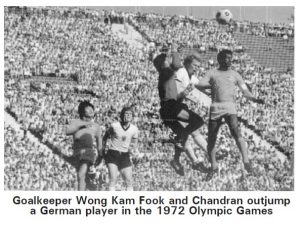
We faced Germany after the opening ceremony of the Olympic Games at the Munich Olympic Stadium on 27th August 1972, and despite losing 0-3, we put up a sterling performance.
For nearly 56 minutes we showed some brilliant ball play which had the Germans in awe. Until than we matched the bigger opponents by slowing down the pace of the game, which the well-oiled German team were unfamiliar with.

Our lack of knowedge of European style of play, and mental strength proved to be our downfall. When the Germans switched to their fast game, we were totally disorientated. The German resilience contributed to their victory.
We made amends two days later by beating USA 3-0 in the second match, but went down to Morocco 0-6, and were out of contention.
As a player, the appearance in the Olympic Games was the pinnacle of my career.
Two years later I led Malaysia to a bronze medal in the 1974 Teheran Asian Games. Again a feat, or rather a podium finish, that’s still unequalled.
It was the only time that Malaysia ever won a medal in the Asian Games football competition, and in that same year, after this victory, I called it a day. I quit, when I was still ahead.
(NOTE: M. Chandran was the captain of the 1972 Olympic and 1974 Asian Games teams).

Nation Before Fame & Fortune

By
N. Thanabalan: In the early years of post-independence, it was passion that drove sports, not the lure of fame or fortune. In the late 60s and early 70s, I remember how we players were content with an allowance of RM2 per day when playing locally and RM5 per day for international duty.
We were happy with the simple meal and accommodation given. The pride was in representing our club, state or country. It was in pulling on the jersey and feeling good just being on that pitch.
Unlike now, we didn’t have the luxury of sponsorships, and so were forced to equip ourselves. I remember begging my parents for a pair of boots, which cost about RM20 then.
Back then RM20 was still considered a hefty price for an average family, like mine and I could only afford one pair of socks. So after every match I had to wash them, so that they would be clean and dry for the next match the following day. But I never complained because being able to play for your team, was all that mattered.
I began my football days, by playing with the older boys in Brickfields, which had many fields then. There was one that was very close to my home at Rozario Street, in 100 Quarters.
I was small in size, which was why I was nicknamed ‘Lilliput’. With the big boys, I knew I would get hit if I wasn’t faster than them. They were tough and even rough, and gave no quarters to the smaller players. But I became faster, and I am grateful for that, because I turned out to be one of the fastest wingers in Malaysian football.
Just as I had a tough upbringing, coming from that neighbourhood, I had a tough upbringing in football too. It was never cushy for us, no glamour, and no luxury of being a national player.
I remember when 15 players would be cramped into one dormitory on double decker beds when training in Merdeka Stadium.
We only had hot tea to look forward to after training, while our coach Choo Seng Quee had a bottle of orange squash in his room. So we would sneak in and help ourselves once in a while, not knowing he had marked the level since he already suspected us.
And even those little gulps of sheer pleasure came with a painful price. For, when Seng Quee discovered the cause of his dwindling bottle of squash, he found his squad guilty and sentenced them to 20 laps around the field at Merdeka Stadium, in the blistering hot afternoon sun, without our shirts on.
Every time there was an unaccounted drop in the squash level, we would get 20 rounds and sometimes more. But it turned out to be a blessing, as we got tougher and fitter than our opponents, through this regimented style of punishment.
And training was never easy, it was tough and demanding. So demanding and punishing, that sometimes we had to tell one another, “Oi!, perlahan la, perlahan” (“Oi! Slow down, slow down”) so we could our catch our breath during training.
And we weren’t spared the Vietnam War either. We were subjected to playing in extreme conditions, including in the midst of this war. For the 1966 Asian Cup tournament, when Malaysia journeyed to Vietnam, the American army were our escort in their armed truck to the match venue.
We could even hear the bombing in the background.
As it turned out that match, would go down in history books as the roughest and bloodiest. Apart from the dangerous conditions, I almost became blind in one eye after taking a nasty elbow hit on my right eye.
I was temporarily blinded in that eye, and I was frightened and was imagining the worst. Fortunately, a traditional Chinese medicine practitioner, a sinseh, was at hand on site. He helped restore my eyesight.
Apart from that, I was also bleeding from my nose, while fellow team mate Lee Soo Pang was on the next bed in the hospital with me, from injuries after he was trampled on.
We were promised an insurance pay out for these wounds inflicted. We are still waiting for it,
But it was all worth it. The beautiful game not only elevated my life, but it gave me so much pleasure and joy. And the pride of donning the national colours, was unequalled in stature.

Thanabalan went on to represent the country in the 1963, 1965, 1967, 1969 and 1971 SEAP Games and the ASIAN Games in 1966 and 1970.

My Pass Out of Poverty

By
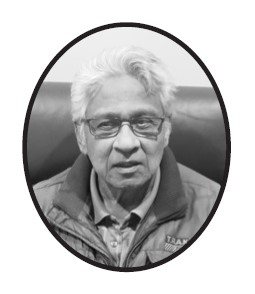
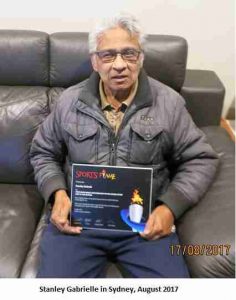
Stanley Gabrielle: My poor mother! When all the gratitude owed by the sons of Adam to their mothers are added up in this world, it would make a pile huge enough to erase the evil done by a great many others. Such I believe is the power of good mothers on this good earth.
When my father died unexpectedly in September 1939, my mother had 12 children aged between two and 16 years, and I was due in 3 weeks’ time. After she buried my father she had no way of supporting the family with her husband’s tiny pension, so she put her daughters in the convent and took her sons up to Ipoh to live with her parents.
My grandfather Martin doted on me when I was a little boy as he was also born after his father died. So I grew up as the youngest of 13 children in desperately poor circumstances. Eventually, my mother got her life back together, returned to Kuala Lumpur and was able to keep her whole family with her again.
They tell me I was a little scamp, running around everywhere and always getting into trouble. It must have been very hard for my mother to control me. By the time I was a teenager I loved sport. On Sunday afternoons I used to go to the park and play football with a group of boys. I knew some of them played for good teams, but I found that I could play well against them. In those days I ran around the field barefoot and had no wish to ever wear boots.
In 1956 I was a 16-year-old working for Caxton Press and earning RM60 a month. The Malay Mail Press was to field a team in a competition organised by the Football Association of Selangor (FAS) for all commercial firms. My boss, Frank Vuilleumier, asked me if I wanted to try out. Wicked as I was, I went for the trials only to get the afternoon off-work.
I wore boots for the first time in that match, played reasonably well and was picked for the team. That’s where it all started.
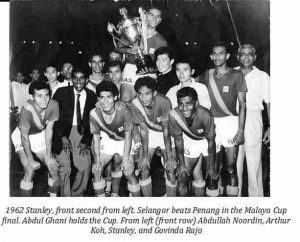
I played with the Malay Mail that year and was spotted by one Mr Albert Foster, manager of the Selangor Rangers. Foster signed me up but to my disappointment I sat on the sidelines for nearly a year. Only when he understood I was about to leave did he give me a game. I played alongside Ray Crawford, who later became England’s striker, and Abdul Ghani Minhat, of the Malayan national team.
When Ray Crawford returned to England I got a regular spot on the team. I only played three games for Selangor Rangers before I was picked for Selangor state. In the first game I played for Selangor I was a bundle of nerves and couldn’t play much at all. I was booed by the crowd from the start to the finish of the game. I have to thank Dato’ Harun Idris, the then president of the FAS. Harun saw something in my game and kept playing me despite my nerves.
I loved my football. I enjoyed playing in so many top teams with so many talented players. I played with the Selangor Rangers, Selangor Chinese Recreation Club, Selangor state, and the Malaysian Chinese Invitation team to Hong Kong, as well as playing for the Malay and Malaysian national sides between 1959 and 1971.
I particularly loved the annual Merdeka tounaments. There were 14 or 15 countries in the tournament and I found it really exciting. We won several times while I was in the team.
In those days football was everything to me and my family followed and supported me all the way. They came to every match they could, even driving down to Singapore and up to Penang. One sister in particular, Doreen, was madly keen on my career. She would attend every match she could and shout all sorts of things from the sidelines. Whenever I got the ball she would pinch whoever was sitting next to her. Woe betide any journalist who criticised me! Doreen would skin him alive in her next letter.
On one occasion Malaysia played against the Football Association of England. Their leader, Tom Finney, was apparenty impressed with my performance and offered me a trial with the Preston North End team in England I took the trial and moved to England but I couldn’t bear the cold and came back quickly.
I remember with great fondness the players in the national team. Abdul Ghani, Arthur Koh, Rahim Omar, M Chandran, Edwin Dutton and Majid Ariff, to name a few. But the one that stands out in my memory is Abdul Ghani. Ghani and I were very close and he taught me a lot about the game. I will always remember him. I also remember the best coach I ever had, Choo Seng Quee.
I was sad I missed some good tournaments through injury. It was so hard to sit on the sidelines. I also saw so many lovely places, but didn’t really stop to enjoy them. In those days it was all about the match. All I really saw was the hotel, training ground and the match. I will need to go back to all those places and see the sights I missed.
In the 1950s and ‘60s there wasn’t a lot of money in the game. We played for the love of it and enjoyed being famous in our country. We could play in front of a crowd of 60,000 people for a RM20 match fee and we got RM2 to go to training.
After my international football career finished, I migrated to Australia in 1973 where most of my sisters and brothers lived. I am getting on now, but I still look back to the great football matches of the 1960s and think how lucky I was to play in such great teams.
In the 1970s and ‘80s, I coached football in Australia and coached such future greats as Tim Cahill, Harry Kewell and Mark Bosnich.
Football has been a big part of my life and I am proud of that.

Lightning Experience

By
Qadeer Ahmad: Golf courses are marked with a number of hazards and sometimes while playing you might land into some.
But there is one hazard, I can never forget. It took place about 35 years ago in Malacca when Kelab Golf Negara Subang went down to play Tasek Utara Golf Club in an inter-club match.
There I was standing in front of the 5th hole tee-box on a sunny afternoon. I was already visualising how to carry my tee-shot at this par-4 hole’s sloping fairway which had a drain hazard cutting across it.
The air was still and you could feel the sweat creeping out of your pores. Otherwise I was oblivious to everything around just concentrating on the challenge ahead.
Then without any warning, there was a very loud whiplash sound, more like a deafening boom. The next thing I knew, all of us on that tee found ourselves on the ground.
Behind us we could see a huge tree charred beyond recognition. Lightning had struck and we felt the ground tremble under us for a split second.
Whether it was from the lightning shock we took a dive or we were thrown, I cannot recall until today.
Within a minute or tw

o, from sunny afternoon, the skies opened up and we were drenched while still on the ground.
Suddenly, we came to our senses and as panic took control we got to our feet. Leaving our golf bags and clubs behind, we got a heck out of there. Scrambling like rabbits, we cut across three fairways to the safety of the clubhouse.
After a while we overcame that nervy frightful experience and to find that we were so near to disaster. We were so lucky not to have been struck by the lightning bolt which struck so close to where we were standing. It was really too close for comfort.
Today I am still playing golf but after that harrowing experience, whenever I notice dark clouds, I will refuse to tee-off.
And I’ve added lightning as a golf hazard to my game.

Let’s Be Humble


By

Tracy Yong: Like any child of a famous, or somewhat famous parent, my three sisters and I always thought of my dad as just that – my dad.  When I read stories about him in the press, all that he was in the public world he was too in his family life.
We are all enormously proud of his achievements yet find it difficult to tell his story without couching it in slightly apologetic terms like, “Well, just famous in Malaysia” or “Well, it was the Malaysian Olympic team”.
On reflection, this was perhaps the part of him that consistently drew others to him; the fact that through all his achievements, and despite all his energy and magnetism, he remained humble.

He was humble enough to know it took hard work to memorise the rules of golf (not to mention the punctuation), and he was just as proud of his proof reading skills: he would read the Golf Club’s monthly newsletter forwards and backwards to check for typos.
To us this made him a normal dad with the usual embarrassing dad traits.  It also meant there was no excuse to not do your homework or do well in school; his example taught us that hard work behind the scenes was the key to success.

He was an affectionate husband (his old-fashioned nickname for our mother was Cherub), but I also remember some of their late night “discussions” with his loud exasperated “Come On” when our mother failed to see things exactly his way.
In an argument with him over why he should let my sister stay out late one night, I remember thinking how I’d hate to face him in court, then complained “Stop lawyering me dad!” It was impossible to get him to concede a minor point once he had an opinion about a topic. And he always had an opinion!

My favorite memory of my dad is him telling his jokes and tall tales.  After University I was briefly a part of my parents’ golf group inner circle.  Friends would take turns hosting dinners, either out or in their homes, and politically incorrect stories were shared to great laughter; no insult was left untouched.

I’ve tried to tell some of the same jokes but it’s true, it is all in the delivery, and his delivery was part of his charm.  Not long after he died, I thought about a story he’d always tell as we drove by a bent tree on the way to Port Dickson.

“Uncle Ming and I sat on that tree as boys and it grew crooked”.  It had taken me 30 years to realise this was impossible. But that was my dad – we believed everything he said because he said it with such charm and conviction.


A Man Called Ciku

By
Cheah Hong Chong: 
IT was one man’s generosity that saw me achieve my Thomas Cup badminton dream.
If it was not for Moe Chin Kiat, I would have been just another badminton youngster with a shattered dream.
I can still remember Moe, who is popularly known to all of us as “Ciku”, giving me the break in 1970 as a 20 year-old student of Victoria Institution in Kuala Lumpur.
In those days, apart from school halls and outdoor courts, we could not afford to play in fully-lit indoor courts, let alone buy shuttlecocks.
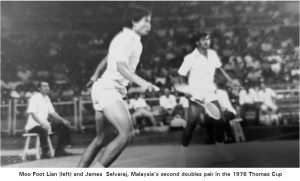
One afternoon in 1970 after our workout with the Shell Schools badminton scheme squad at the Kampung Pandan Sports Centre, Kuala Lumpur, we were watching a group of boys and girls in action. With me were Phua Ah Hua, Moo Foot Lian and James Selvaraj, all of whom became my Thomas Cup teammates in 1976.
In the midst of these young boys and girls was this smiling man in white shorts. He looked approachable and so we walked up to him and asked: “Could we join your group.”
That person was Ciku. His immediate response was: “Come and join us.”
It was a very gracious invitation and we became members of his “Merry Juniors Club” and we began to receive additional coaching under the capable hands of “Ciku”.
He paid for everything, the court fees, shuttlecocks and even supper whenever we trained at night. We trained twice a week without any worries.
Ciku’s Merry Juniors Club became our real training base with its highly competitive environment, and soon it attracted many Selangor junior and budding national players to its fold.
Although this club also had many adult members, Ciku paid special attention towards his band of youngsters during training. However the adult members were very supportive of us.


When I joined the Thomas Cup training squad in 1973, Ciku’s fatherly nature landed him the post of “camp commandant.” We were based at the MABA House in Kuala Lumpur. He was assisted by Michael Chan, in the training of this bunch of “no hopers” in their Thomas Cup quest.
Ciku was very serious as “camp commandant.” He had the first room facing the elevators in MABA House!” The door to his room was always open so he could see who was coming or leaving the rooms. We were watched all the time like a bunch of “schoolkids.”
We were always mindful of Ciku’s watchful eyes. He kept an immaculate record of every trainee…..what we did, where we went. He was the first to wake up and the last to sleep. Always making sure that all his charges were safe.
His timing for everything was like clockwork. Our wake-up call was always two knocks on the door and on the dot every morning. To shake us out of our sleep was that early morning jog. This was followed with two hard boiled eggs ready and waiting for us after the jog.
He played many roles in the training camp. He was timekeeper of all our drills and runs. He knew who was the fittest as he kept a record of all of us. After a hard workout, he was our physiotherapist, our nutritionist, racket stringer, caretaker, and driver.
In all our matches, Ciku was always on hand with the energy drinks (glucose) and deep heat to soothe our aching muscles…. we were in that era of energy sapping “service-over” scoring system.
After our gallant 1976 Thomas Cup runners-up finish to Indonesia Ciku helped secure jobs and promotions for most of us. As for me, he was instrumental in getting me a scholarship from the Kuok Foundation.
Ciku’s passion and dedication for badminton has not diminished. Though he has shied away from the mainstream badminton due to “politics”, at age 80, he continues to pour his remaining years of energy into Paralympic badminton.
Malaysian badminton is so fortunate to have had the untiring services of this man, who never sought the limelight. I salute you Ciku for your contribution to Malaysian badminton.

Behind The Iron Curtain!

By
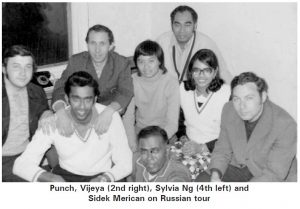
Sylvia Ng: I’ve never shaken so many hands in my life! We shook hands from the time we stepped off the plane, and all the way to the hotel.
We arrived in China in 1976, way before China opened its “bamboo curtain” to the world, for a friendly exhibition/exchange badminton match. The VIP treatment we received was truly unbelievable. From the lavish meals to playing in a huge stadium with so many people, was humbling.
The general public still wore black/white, and only 130,000 motorised vehicles were on the road in Beijing against the millions of bicycles. I was the only female Malaysian athlete privileged enough to witness this.
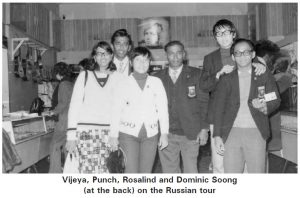
MINUS 36 DEGREES: We arrived in Moscow in the late 1970s during the “Cold War” where the thermometer read -36 degrees celsius. We wore layers upon layers of “Malaysian winter wear” that was no match for the Russian winter.
I played a match in my full tracksuit for the first and the last time because of the biting cold. Not wanting to be beaten by the cold, I stripped down to my shorts and T-shirt. But my battle against the elements lasted for all of three points, before I halted the match to put my tracksuit back on.

If you want to know how cold it was, during my mixed doubles match with Dominic Soong, his glasses actually cracked. He had to borrow a pair of spectacles, to keep the match going. To the entertainment and amusement of the crowd, Dominic in his borrowed glasses, made a few air shots. It was funny even to us. And as he didn’t have the luxury of having a second pair of spectacles, we tried very much to glue his broken glasses together.
As tourists, we went to view Lenin’s tomb in the Red Square, which meant we had to wait outdoors in the world’s longest queue and in sub-zero temperatures.We couldn’t feel our feet, and if we thought there would be reprieve from the cold once inside the warm mausoleum, we were downright wrong. It lasted for all of three minutes, before we were quickly ushered out into the cold.
The Russians noticing our plight, thankfully, midway through our visit, gave us winter wear.
VULTURE OR CHICKEN?  During the 1975 Uber Cup in Lucknow, India, we missed our local fare so much that we offered to cook a meal for ourselves by requesting the chef, for chicken.
Vultures were a common sight back then in India, so when we were provided the “chicken” we joked that it could have actually been a “vulture”.
Ultimately, out of desperation Katherine Teh and I cooked up a storm with the “chicken”. No one complained. Everyone had a hearty meal, and we went on to beat India 6-1.

Not To Worry

By
Nazamuddin Yusof: Turning pro was the easy part. Making a life out of golf in the early years was more difficult than I had ever imagined.
After five years as an amateur and being acclaimed the best, I joined the professional ranks on December 3rd, 1976 as an impressionable 19 – year-old.
In my rookie year, I showed some great promise, winning the Federal Flour Mill Open title and finishing third in the Credit Corporation Malaysia Classic. But I was not satisfied with my game. I was playing only against my fellow country mates. I wanted to compete with the outside world.
To improve myself, I knew I had to compete on the Asian Circuit where I had to play with the best Asian, European, American and Australian players under different climatic conditions in 10 different countries.
I set my sights on it but I needed to find the  money to embark on this journey. I set out to seek sponsors, and that’s when I found that nobody and no corporation was willing to help local golfers. I found myself in a hopeless and helpless situation.
Dejected and disappointed, I returned home to Ipoh. After a short game with racing jockey Chris GWilliam, on the 9-hole Perak Turf Club Course, we settled down for lunch. I found myself lamenting to him about my predicament.


He asked me how much money I had. I told him I had only RM800, when I needed RM8,000 to play in some of the tournaments on the Asian Circuit.
What GWilliam said next was what would put me on course, in more ways than one, on my career as a golf pro. He told me to put all my money on a horse called “Not to Worry” which he was going to ride that Sunday.
Imagine that. And that too on a horse named ‘Not to Worry’. It was as if there was a message of reassurance for me, a fledgling golfer who just turned pro, and given my dire straits, worried if I would succeed.
I am not ashamed to tell this. I went for broke and placed the RM800 on “Not To Worry.” It was a one chance in a million, and if I made a winning, I was on my way to the Asian Circuit. But if I lose, I would be penniless, and my pro career would have ended even before it could take off.
Life, as I was told, is often a game of chance. And  I took mine, on a horse called “Not to Worry”. As it turned out, the horse won, and I pocketed nearly RM8000. I did not have to worry, I was on my way to the 1978 Asian Circuit. It was more than enough to sustain me for six tournaments, round trip air ticket, accommodation, caddie fees and food.
I did not win any money on the tour but the experience I gained playing with the likes of Graham Marsh, Payne Stewart, Lu Liang Huan, Hideyo Sugimoto and many others put me in good stead in my 17 years as a playing professional before turning to teaching and golf course management.
People and events in my life as a golfer:
Zainal Abidin: My elder brother who was a great influence on my career. He showed me a lot and was a great teacher. In fact I picked up the game when he was the resident pro of the Royal Perak Golf Club. He asked me to take care of the driving range as a 16-year-old schoolboy. I used to watch and laugh at the many members at the driving range. It was comical as they would hit the balls in all directions. That was when I told myself I could do better than them, and that was the start of my golf journey.
Walter Godfrey: He told me you have to venture out into the big pond. No point fishing in a small pond where you can only get small fry. Try to swim in the ocean and compete with the big fish then you will know how good you are. I took his advice and competed in the Australian Circuit with some of the world’s top players.
Graham Marsh: In one Singapore Open I was paired with Marsh in the final round. After the 18th hole, he shook my hand and said: “You know Naza, this was one time I did not get the honour of teeing off first in all the 18 holes.” Only then did I realise, I had the honour throughout and I beat him in that final round.
At lunch he gave me a tip on how to gain respect. You have to give your time to the media. Always treat the press the best you can. They can build you up or they can bring you down.


George Das: In those early days when golf did not get much media play, he promoted the local pros and the Malaysian PGA circuit in the New Straits Times. To a great extent he helped boost professional golf in the country and many of us got to be recognised by the public and potential sponsors.
He was like a big brother to me and whenever I had a bad round, he would always encourage me to “forget yesterday and concentrate on the next round.” The amazing thing about him is, he’s not a golfer, but he read as much as he could about the game and its rules. He was always in our midst, questioning us and seeking answers. I even travelled with him to two Mizuno Golf tournaments in Osaka.
Qadeer & Hamid Ahmad: When Dunlop Malaysia turned me down by saying that they did not sponsor local pros, I was introduced to these two brothers by Ramlan Harun. Without asking me for a biodata of myself, they signed me on. They ran a sports shop “Car & Company” which held the Mizuno Golf agency. From then on I did not have a problem about getting golf equipment.
Walter Hagen: I never met this great golfer, but 50 years ago as an 11-year-old schoolboy in Ipoh, I found a broken 8-iron Walter Hagen club. I was walking by the 6th hole of the Perak Turf Club course when I picked it up from a bush. I restored it with a “new” shaft made from a discarded iron bar and wrapped a cut-up bicycle tube for the grip. This was my first club but I just hit around with not much interest. Football was my rage.


Dunhill Cup 1991: After helping Malaysia qualify for the final in St. Andrews, I was unceremoniously dropped from the three-man team to Scotland. It was the most disappointing moment in my career. After this my game started to slide and I quit my playing career in 1993 to take up a job with Tanjung Puteri Golf Resort and helping build the course to a reputable international standard.

Benson & Hedges Classic: The biggest pro title I’ve won was the 1986 Singapore PGA. In total I’ve captured 19 professional titles in my career of which were six Benson and Hedges Classic tournament over six years. This probably is a record in the history of this event.

Dicing with Danger

By
Johnson Fernandez: It was a little past 1.0am when my wife called. “Are you on your way home?” she asked. “Yes, I am back,” I replied. “But I didn’t hear you,” she said. `My wife does not sleep until she hears the main gate being opened and closed and the beep of the car’s reverse sensor. When she knows I am safely in, she’ll automatically knock off. Unbeknownst to her, I was parked about 100 metres away, as I usually do, whenever I return home late after Malaysia Cup matches or a Friday night out with the boys. I just want to be sure there were no trackers, before I enter the house. Cautious? Paranoia? Well, both. I have had death threats. Contracts actually, which were not unusual in our line of work. This particular story (there are others, which I shall get to later) is one of many reasons for that. It was in March of 2003 when I received a call from a contact in a State FA. This was a team I covered regularly in the M-League.
“Do you have a minute? This is important,” the caller said. “Yup, what’s up?” I replied, the rest of the conversation taking a dark turn. “I just got out of a closed door meeting. I know you as a friend and I don’t agree with the discussion regarding you.” I waited. I suspected it was going to get more sinister. “Be very, very careful. They had just put a contract out on you.” When I asked who else was at the meeting, he rattled out a few names. I responded: “You mean the top man was there too?” My contact replied: “I am very sorry to tell you this, but it was his idea.” I profusely thanked my contact for the heads-up. Now what, I thought. I was not about to change my style of writing, that the truth will always be told. I was not going to be intimidated. But I had a young family.
My wife was a home-maker. My three children were teenagers – my sons were 17 and 16 and the youngest, a girl, was 13. Needless to say it was a sleepless night as I contemplated my next move. As I mentioned earlier, I was not going to compromise. I can’t even recall if I ever discussed it with anyone, definitely not with my wife. My concern was the future of the family. If ever something was to happen to me, they needed to be on solid ground.
The next day I made an appointment with my insurance agent. “I want a life policy for RM1 million,” I said to him. “No matter what happens to me, how it happened, why it happened…if I am killed, I want my family to receive RM1 million. My wife should be the sole beneficiary. Work out the premium.”
Shocked at my hitherto unseen agitated state, he asked for the reason and I related the story to him, in strict confidence. Fifteen minutes later, after consulting with his bosses, the agent reverted with a figure and the deal was done.Well, I have lived to write this story.


So, what happened? Some months later, I bumped into my State FA contact and I did ask him. “Though there were not many of us at the meeting, still there were one too many. If it had happened, someone would talk. As a politician, the boss had too much to lose. Too much of a risk,” he explained.
I wish I still had the policy to authenticate this story. Only last year, I cleared all my old files, which included this lapsed policy certificate. However, my insurance agent was able to trace the approved application form for the policy. It would be pertinent to point out here that particular policy was for only one year.
I have learned to look into the rearview mirror at every turn I took. I used different routes to and from work. Became more aware of my surroundings, looking if there were loiters near my car when I was done with my pints.
No, not because of this one incident. There were others. Several years earlier, there was another contract hanging over my head. And I know this because the “contract-holder” himself told me about it.
I can’t remember the year, except that my daughter had not been born yet. I had my two sons. So, it would have been sometime in 1988-1990., and the boys would have been two to four-years-old.
This time was a State team official. I turned up one day for one of my many football assignments, and this person is there as well. He sees me, walks straight up to me and without even blinking he says, rather callously: “Go and thank your wife and kids that you are alive today.
And he walks away from me but remains in the function hall. I was stumped. What was that all about, I thought to myself. Of course, I confronted him after the event and he tells me that he had me tailed for three days.
On the day of the hit, or just before it was all supposed to go down, the “contract killers” had called him to confirm the assignment. “I asked them where you were. They told me you had just got into your car. I asked them if anyone was with you, and they replied a lady and two little kids also got into the car.
“That’s when I called it off. I thought about your wife and children. If you had been alone, we wouldn’t be having this conversation now,” he said. It is strange though how that caustic relationship with that official matured into one of mutual respect. We remain very good friends today though. Occupational hazard
I could write about how a national hockey fullback, when I turned up while they were practising, sent a high ball in my direction because he didn’t take too kindly to my description of his performance in a tournament.


I heard the whistle of the wind in my left ear as I dodged the ball. The national coach saw what happened which resulted in practice being stopped and a dressing down for the fullback, all out of earshot (pun intended!) of course.
The threats on my life didn’t come only from this side of the Causeway. There was one from Singapore which I vividly recall. I was not amused that someone had given my home number to this person, who was a regular on the Malaysian golf circuit.
It was about 3.30 in the morning when I was forced out of bed. When the phone rings at that time of the day, it’s always chilling. You fear the worst. A death in the family, perhaps…Then, I hear this unfamiliar, irritated voice booming at the other end of the line: “Hello, is this Johnson Fernandez of The Malay Mail?”
“Yes, but who is this?” I ask. He retorts: “I am ……. (Name withheld). You don’t simply implicate me in match fixing. You better watch what you write.”
Excuse me, but I had not mentioned this sorry-excuse-for-a-golfer’s name anywhere in any of my numerous reports on the bribery scourge that held Malaysian football by its jugular at that time.
But, I had implicated a Singapore pro golfer who plays regularly on the Malaysian circuit as a “fixer” for infamous Singapore bookie Rajendran “Paal” Kurusamy. I had not mentioned names.
As the Malay proverb goes “siapa makan cili, dia rasa pedas”.Or, the English equivalent: “If the hat fits, wear it”.
Even after I had clarified that I had not mentioned anyone by name, especially given there was a large horde of Singapore golfers on the Malaysian and Asia-Pacific circuits, the ranting didn’t stop.
“Don’t f..k with me. You don’t know what I can do. Don’t you dare step into Singapore. You will never return to Malaysia,” he threatened. Sick and tired of the ranting of a lunatic, I just said “F..k off”, slammed down the phone and left the receiver off the hook. I needed my sleep. I was in and out of Singapore numerous times after that. Still here.
Yes, we took the risks. We didn’t write to please. We wrote as we saw it, we fashioned our thoughts without fear or favour.
Would I choose this profession again? Without a second thought!

MOST COMMENTED

- Advertisement -